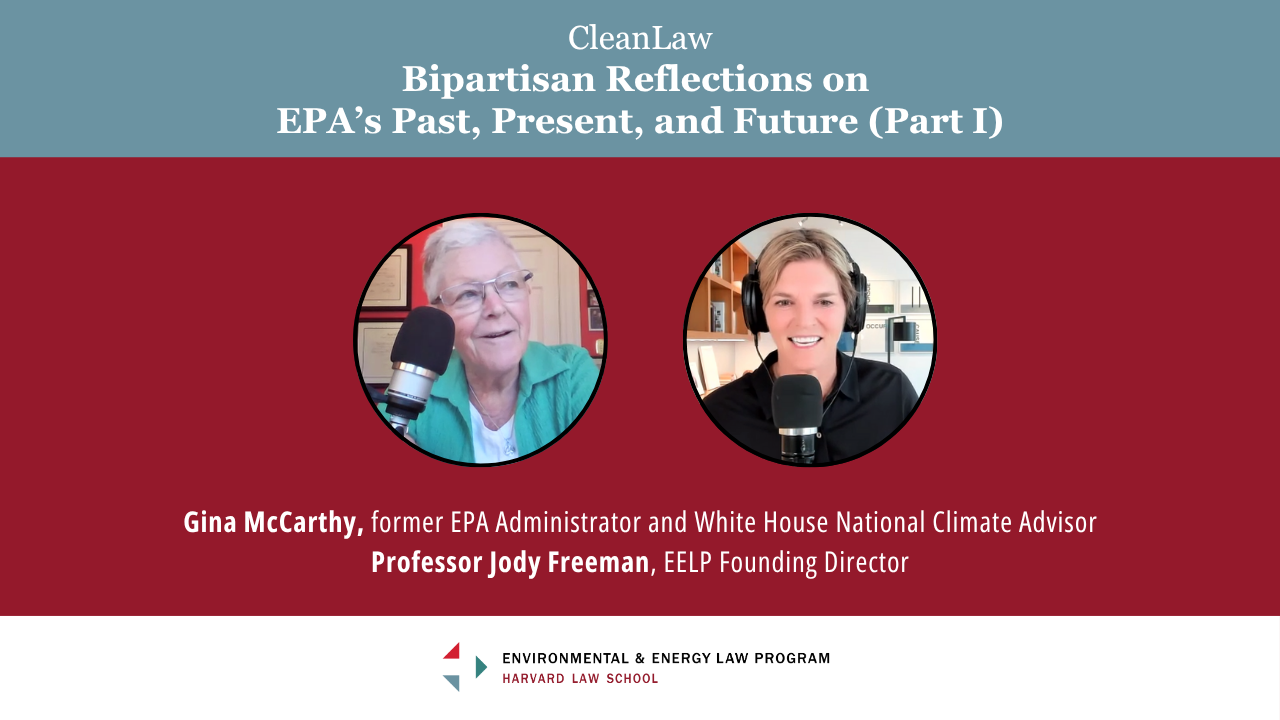
In the first of this two-part series, EELP’s Founding Director and Harvard Law Professor Jody Freeman speaks with Gina McCarthy, EPA Administrator under President Obama and the White House National Climate Advisor under President Biden, and Managing Co-chair at America Is All In. They discuss Gina’s time at EPA, including the agency’s mission to safeguard public health and the environment through actions that rely on robust science, technology, data, and policymaking expertise. They also review current actions by the Trump administration and discuss how private and nonprofit stakeholders and federal and state policymakers can work together to make progress on climate change and other environmental and public health issues.
In part II of this series Jody speaks with William Reilly, EPA Administrator under George H.W. Bush, and Christine Todd Whitman, EPA Administrator under George W. Bush.
Transcript
Intro:
Welcome to CleanLaw, from the Environmental and Energy Law Program at Harvard Law School. In the first of this two-part series, EELP’s Founding Director and Harvard Law Professor, Jody Freeman, speaks with Gina McCarthy, EPA Administrator under President Obama, and the White House National Climate Advisor under President Biden. They discuss Gina’s time at EPA, including the agency’s mission to safeguard public health and the environment through actions that rely on robust science, technology, data, and policymaking expertise.
They also review current actions by the Trump administration, and discuss how private and nonprofit stakeholders, and federal and state policymakers, can work together to make progress on climate change and other environmental harms. We hope you enjoy this podcast.
Jody Freeman:
Welcome to CleanLaw. Today, we have a special guest, Gina McCarthy, who is probably known to almost everyone who listens to our podcast, but I will introduce her anyway. Gina served in several roles in the Obama and Biden administrations. She has, of course, a long history of government service before joining the federal government, but she served as assistant administrator at EPA for air and radiation from 2009 to ’13.
She was then the Administrator of the Environmental Protection Agency from 2013 to ’17, and then in the Biden administration, served as the White House’s National Climate Advisor from 2021 to ’22. I am delighted, Gina, to have you with us for a talk today about all things environmental, EPA, and Trump administration. Welcome.
Gina McCarthy:
Thank you, Jody. It’s great to be here. With that introduction, it makes me feel even older than I actually am, but I’ll try to live with that.
Jody Freeman:
Well, it’s just so accomplished. That’s how I view it. Gina and I know each other a little bit from working together during the Obama days, and Gina is one of my favorite people from that time from service in government. I’m a huge fan of yours, and I have great memories of our time collaborating together. Today, what I want to focus on first is giving people a very brief lay of the land so they understand what the Environmental Protection Agency does and who works there.
I want to do this because as you know, and as many of our listeners know, there are some changes afoot. The administration’s being transformed even as we record this, and I want folks to understand what this agency is all about. Let me just say a few things to introduce it, and then I’ll have you elaborate a little bit. EPA has about 15,000 workers, at least historically, it has 10 regional offices that work with the states to implement environmental law. EPA sets standards for clean air, clean water and other things.
It has a role in collaborating with states, even when states are leading on implementing environmental standards. EPA also responds to disasters and emergencies, and it’s a deeply science-based agency that’s committed to environmental protection and public health. That’s my briefest of overviews. Gina, since you ran it, can you add some commentary on how the agency works?
Gina McCarthy:
Well, Jody, I think it was a great summary of what US EPA actually looks like. I think just to get into the nitty-gritty, what it does, and not too much, I think people understand that we do regulations and things, but basically, EPA’s mission is to protect the public health and safety. It is all about keeping people having access to clean air and clean water. It looks at industrial sources and tries to reduce those as much as possible.
It works with states and communities in usually a hand-in-glove way. You actually can do a lot of work to authorize reductions in emissions, whether they’re traditional emissions or greenhouse gases, using the authority of EPA. At the same time, states can go further than that, and very often do. The folks at EPA range from everything from scientists, to lawyers who look at what the laws are currently, what they do, what they can do, opportunities for adjusting that.
EPA is basically an agency of, I think now, it’s closer to 18,000 employees. It’s always had a pretty small budget, all things considered. That went a little bit better during the Biden administration and is not going to go so well, I think, during the Trump administration. Really, the way we do things at EPA is we rely on the science. We rely on our understanding of what the law says, and we look very carefully of what EPA’s obligation is to continue to advance regulations or policies that meet its mission.
It’s more straightforward than people think, but it’s filled with folks that are good at writing laws, good at analyzing data, good at communication skills, and how you work through all of the challenges associated with what EPA is doing, and how do people figure it out, and how do we explain it to them. It’s a vibrant organization that’s really crafted very much to, as you mentioned, 10 regional offices. That’s where a lot of boots-on-the-ground work gets done. That’s where you look for inspections, and are people complying under the law?
They do some of that at headquarters, but a vast majority is really done with boots on the ground, working with states and local communities to try to figure out how we can all not just do what the law says, but do what’s best for people and our communities.
Jody Freeman:
I wanted to ask you about coming to EPA from your role in the states. You had roles both in Massachusetts and in Connecticut, heading up their Department of Environmental Protection, deeply experienced in local public health work and pollution control. I wanted to ask you about that.
Flipping from the state level to go be a leader at the federal level, and were you surprised about anything you discovered? Were you frustrated by anything you discovered? How does the perspective that you brought from the states inform your roles at EPA?
Gina McCarthy:
Yeah, I was excited to go to EPA at the time. I can remember being asked by Lisa Jackson, who was the incoming US EPA Administrator under the first term of President Obama, and I can remember she called and said, “Hey, Gina, do you want to come?” I said, “Absolutely.” She said, “What is the thing that you’re most interested in?” I told her, “I only want one thing. I want the Air Program.” To me, that was where both my understanding of how things work and the juice was really at the Air Program.
I went there, fully knowledgeable about what was going on at the state level, and I got there realizing that I was like, I felt like a kindergarten kid at a commencement graduation ceremony from Harvard. I realized I knew so little compared to what that agency did. It was just extraordinary. I had no idea of how difficult it was to write and defend regulations, and how we had all different offices like the folks down in North Carolina, who did some of this work on the Air Program, and others that were directly within EPA’s headquarters in Washington DC.
It, to me, was one of the best learning experiences that I certainly ever had. It was like drinking through a fire hose for sure, because of how much needed to get done. It was wicked fun at the beginning, honestly, and it remains so. Jody, as you can imagine, you went there, and you had questions from the White House, you had questions from Congress, you had hearings to go to, which I did certainly my fair share and more over the eight years I was at EPA.
It was great, but I think it made me realize just how hard that agency works, and filled with folks that have expertise in areas that I never even thought to think about. It was wonderful.
Jody Freeman:
I remember when we worked together in the early days of the Obama administration, we worked on the car rules in particular, and we all got to visit the lab in Michigan. It’s so impressive, the auto testing lab, where they sort of take cars apart and figure out what technology can do to control air pollution coming from cars. There’s a lot of engineering along with the science that you have to understand to write these regs.
What’s so interesting to me is, as you alluded to, the legal steps to write these regulations and defend them. You’ve got the courts, you have to make sure you can survive judicial review with these rules, that they’re robust and defensible economically, but also that they fit within the legal parameters of the Clean Air Act. It’s a multi-step process. The agency has all these experts to make sure that they do it correctly, and then there’s a public participation process and a public comment process.
You lived through several major rulemakings that end up being called packages that get sent over to the White House. As you mentioned, you go back and forth with the White House. I wanted to ask you about some of these major accomplishments from both the Obama administration, the Biden administration. We, of course, could spend hours and hours talking about this, but I want to hit the highlights that everybody already knows something about.
Can you comment a bit on getting the, for example, transportation standards through in the Obama era, the first set of greenhouse gas standards from cars and trucks, and using the Clean Air Act to regulate CO² pollution for the first time, and the Clean Power Plan, which of course, you spent years working on, only to have the Supreme Court eventually, many, many years later, strike it down, never to see it implemented because the Court stayed it, and then the methane rule and so on.
Can you give us just an overview of the enormous amount of work for those early rules that were the first greenhouse gas rules in the United States of America under the Clean Air Act at the federal level?
Gina McCarthy:
Jody, I can tell you that one thing may illustrate it better than others is, as you’ll undoubtedly remember, the challenges of working with the White House were in and of itself difficult, only because when folks get to the White House, they become immediate experts in something. Of course, I went there, and I was certainly not an immediate expert in anything. There was so much back and forth, which properly it should happen in the White House, in talking to all of the advisors and scientists that had their own shtick there, as well as talking to all the other relevant agencies who had information or expertise.
It was an extraordinary eye-opening experience, but it also meant you had to deal with the business community if they were the impacted one, or local communities, if it had to do with water quality. It was amazing how much touch you had to have, and rightly so. One of my first lessons when I was assistant administrator is to learn just how difficult and long it takes to do these rules, starting with just doing some analysis across the board of who’s impacted by it, what are the issues we need to look at?
How do we gather more information? Are there gaps that would not allow us to move forward with the regulation, because we don’t know enough in certain areas other than it may be impacted? In bringing all those folks together, we met with businesses constantly over these issues, in both productive and unproductive ways, as it turns out. We had to meet with folks at the White House who had legitimate concerns about issues. There were times when I had to sit down with the President of the United States to explain to him and his senior team what to do.
If you look at it, the one example I give, I think, the most I mention is the Clean Power Plan. The reason is that I literally learned when I was doing the Air Program that it would take forever to do these rulemakings. I started probably within the second year of my being the assistant administrator to actually begin to do the outreach I thought would be needed, to eventually, in the next four years, I started preparing then for what I knew would be a four-year horizon to actually get something on the table, and find the juice within the next year to get it passed.
Jody Freeman:
What’s so interesting about this, Gina, is the internal workings of the White House mean that you’ve got several touch points, as you mentioned. You’ve got the folks who are in the National Economic Council, you have whoever’s in the Climate Office where I was originally in those days, right? Well, you’ve got the CEQ, Council on Environmental Quality, which is outside the gates, but still has a role.
You have various internal operations, OIRA, the Office of Information Regulatory Affairs, that generally, folks can’t see Gina, but her eyes just rolled slightly, only because most administrators encounter OIRA as an obstacle, because their role is to check your cost-benefit analysis and maybe suggest some changes to your rules. What you’re saying brings it to life, the life that agencies live, which is not that they on a whim decide to regulate.
They have to go through all these checkpoints, and as you mentioned, they have to deal with stakeholders that have enormous interest: the regulated community, but also the environmental groups, public health groups, right, Gina? Even your days at the state level, I remember, and I’ve read interviews with you, where you talk about communication, explaining what you’re doing, and engaging with the affected communities.
You’ve done that your whole career, and I know you’ve talked about it a lot. Can you just say something about communication? I ask partly because we’re getting very different kind of communication from the current EPA administrator, and the White House doesn’t look like it’s at arm’s length at all from the current EPA, and I want to get to that. First, can you explain your approach to communication and your approach to trying to keep the White House a little bit at bay, so you could do your work?
Gina McCarthy:
Yeah. You’re bringing me back into some both fun and difficult times. I’m sorry for rolling my eyes when you said OIRA, but honestly, it was just another one of those, I like to call it stepping stones, but sometimes it was like blockages, walls. It’s been enormous. To me, I try to continue to focus on honing in communication about what we’re doing and why, so that every human being has a chance of understanding what it means to them.
That is what gets you over the finish line is if you explain to them that the effort you’re taking are going to be as reasonable as you can, so that costs don’t escalate, keeping the cost to the minimum, but even more importantly, it’s about how do we learn from our scientists and researchers about what are the impacts you’re experiencing now, and what do we need to do to make those impacts lessen, so that you can actually live a better and a healthier life?
It became very clear to me when I went to EPA that the work you do in Massachusetts and Connecticut varied enormously from what you were looking at in Mississippi and Louisiana, and not just on air, but on the water challenges. You had to get that sense of, it was an enormous sense of responsibility that not just me, but everybody in that agency embraced, because they knew what they were fighting for. They knew what science they needed to have to have the best understanding of how to act and move regulations and policies forward.
Every time we had a new issue, we didn’t just sit in our own offices. We had every office engaged because we had to, because these issues involve more than one constituency or more than one impact assessment. It made it a very lengthy process. Frankly, if we hadn’t done that, we would have not done right by the constituencies we were serving. Also, I wouldn’t have gotten things through the White House. I wouldn’t have gotten things through OIRA unless I could explain how we got there, who was involved, what is the science, what does the numbers look like? What’s the cost going to be?
What kind of health impacts are we going to translate? What does that mean? All of those things went into that work. Lastly, EPA had his own constituency groups. Good lord, everybody had constituency groups. It meant that we had environmental justice advocates. We worked with them all the time. We had business constituencies in different sectors that we had to work with all the time in order to understand what their needs were, what the opportunities were there.
I look at the Clean Power Plan as a culmination of all of that, and certainly, we did way more than that, but that was the most complex set of discussions I ever had to have, because it was more meaningful than others.
Jody Freeman:
That plan, of course, was about trying to figure out an approach to decarbonizing the electric power sector to set federal standards that would help drive the power sector in a cleaner direction, right? More renewables, more natural gas for a time instead of coal, standards that could be achieved while preserving reliability of the system, and shoring it up in a way that was economically effective. And yet the Clean Power Plan never gets implemented, as we mentioned before.
You’re going to go down in history for being the administrator that presided over the first set of greenhouse gas rules to come from the federal government, and it’s a massive achievement, starting back with the transportation sector standards, the first ones, then through the Clean Power Plan, then through methane, and on we go. It’s really the first climate change rules that the federal government passed. Yet some of them ran into more roadblocks than others.
When the first Trump administration took over, they set about rolling back those rules in a very systematic way: the car standards, the power sector standards, the methane standards, and so on. There was a period of time when we were watching the policy pendulum swing in the other direction, which often happens when Republicans take over, and it goes the other way when Democrats take over. You’re used to normal policy swings. What I want to ask you about is the nature of the swing and how different it is now, now that we’re in the second Trump administration.
Before we get to that, a pit stop on the Biden years, because it’s important to talk about what the Biden administration did differently than Obama before we get to Trump. Just a pit stop there, your role in the White House during the beginning of Biden’s term, when you were setting the course, you did different things. Industrial policy was the strategy. It was to get the Inflation Reduction Act through Congress. The regulatory levers that you had pulled during the Obama years, where we all talked about using executive power to set these standards through the Clean Air Act, because Congress wasn’t doing anything.
That policy changed, because you managed to get legislation through the Congress. Can you talk about that shift, and what you accomplished in the Biden years, and then we’ll get to the Trump era?
Gina McCarthy:
Well, let me make first a little comparison, and one is the Clean Power Plan, you’re right, it never did go into effect because it was taken away too quickly, but just to be clear, it galvanized the electricity sector to look at different technologies and to make a movement that would actually be beneficial to them and the communities that they served. Even though I was looking for a tiny little shift when I wrote that, what did I get, 3% reduction or something for all that work?
I did it because the weird thing about human beings in the business community is once they’re in for a penny, they’re in for a dime. Then they’re in for a dollar. They figure out how to continue that momentum moving forward. While it ticked me off that the Clean Power Plan was blown up, I saw the change in the power plant sector anyways, and that was momentous, at least for me.
Jody Freeman:
You’re talking about a theory of regulation, I think. That is, you send a signal.
Gina McCarthy:
That’s right.
Jody Freeman:
The private sector responds that signal and goes even further, and even better if your signal’s already in the direction they want to go.
Gina McCarthy:
That’s exactly right, or if you can show them there’s cost benefit to it. You have to. You have to always think of cost in these things. How that got translated into the Inflation Reduction Act is that I was the White House National Climate Advisor then, and what we were trying to do is that we had taken already five months of discussions with the business sector, with NGOs. You name it, we had it coming into the White House. We had our little masks on, we did all kinds of Zoom calls and other things to sort of get a sense of where people were.
The unique thing and the reason why I went to work with President Biden was because his focus on jobs and the economy, and health, and community was so good. It was exactly what human beings needed to begin to rally around, and that includes the business community that was suffering from the huge economic downturns of COVID. The Inflation Reduction Act was an outgrowth of those conversations. We looked at every sort of sector that we could look at: the solar industry, the renewables industry.
We went through every single piece, and we realized, I think together, that we could develop an opportunity framing around this bill that would make it much less difficult to get through Congress on the Hill. We had to have something that was a beneficial framing and that would move things forward. We looked at it from the standpoint of what communities have been left behind? How do we generate investment money into those communities?
We use tax credits in order to generate that momentum, and give businesses a chance to start elevating their ability to actually move forward with the companies that they wanted and the innovation that they were looking to accrue. It simply worked. The Inflation Reduction Act was all about investing, and it got through on the Hill because we did momentous work across the White House in the agencies. Every single agency head was involved in this discussion.
When we were framing the Inflation Reduction Act, you did not put a number two at that table in the White House. You put the number one.
Jody Freeman:
The principles were there.
Gina McCarthy:
All of the agencies were beholden at the highest levels to actually look at how we could make this work as an opportunity and investment.
Jody Freeman:
Let me just interject there, because you didn’t just do the Inflation Reduction Act when you were there, which passed really only with Democratic votes. It went through the budget process, reconciliation, but you also got a bipartisan bill passed, which is another huge accomplishment, which was the Infrastructure bill. Both of these statutes, as you mentioned, contained climate policy in the form of tax credits for renewable energy, tax credits for buying electric vehicles, money to fund electric vehicle charging infrastructure, money to fund factories and installations to promote domestic battery manufacturing, and innovation, and so on.
It was a long list of what could be argued was economic policy, along with decarbonization policy. The money was spread out across the country. I think in retrospect, the majority, overwhelming majority of it, went actually to states with Republican leadership. It was a bill that was not designed just to benefit some narrow category of people who kind of like climate policy. It was an industrial policy strategy.
Gina McCarthy:
Yeah, and it wasn’t that we purposely decided to move 80% of the investment to Republican districts. It was that Republican districts were the ones that needed the money the most. It wasn’t a political decision. It was a decision based on information and data. We wanted to drive innovation across the United States, but not just to benefit the states that already had done a lot of work to make the shift to renewables, but to put it in districts that really needed those jobs.
The ones that would really have opportunities that they never had before to build industries, to bring benefits to their communities, and that was a Joe Biden framing. It was one where maybe we’re both old Irish people, so we hang out together. That’s why I went too, because you sort of recognize that there’s a human side of this that really, we had the opportunity of a lifetime to do that I never would’ve expected before.
Jody Freeman:
The other thing that happened, I think that’s worth noting, and then I will ask you about the current administration, is that the Biden team doubled down on the environmental justice work that the Obama administration also was very serious about, and you were involved in both. Can you comment about that, because there’s an awful lot of misunderstanding about what environmental justice means and what, for example, the offices in the agencies that are about environmental justice were focused on. Can you say something about the commitment to that?
Gina McCarthy:
Yeah, I think the commitment to environmental justice was extraordinary. It was not hidden. It was fully intended from day one. Environmental justice was really understanding that we have many states and many, many communities that simply didn’t have an opportunity to grab the terrific new technologies that were now on board and ready to go. It wasn’t a policy that was designed to restrict anyone, but it was intended to understand that there are communities that have literally been left behind, that have been disinvested in for years.
In the United States of America, that’s wrong to allow that. We purposefully looked at where those opportunities would arise, but we did it with the folks on the Hill that represented those districts. No. Did they vote for it? No. Did they want to see it happen? Oh, you bet they did. Then when we finally got over the vote on the Hill and realized that this was going to move forward, we could immediately see where those investments were.
We understood that in those Republican districts that had been disadvantaged, environmental justice communities were going to be allowed for the first time to really have the kind of investment that much of the rest of the country enjoyed. We did the same thing at EPA. US EPA moved forward with environmental justice grants that were specifically designed to make sure that there was equity here. Equity is not a bad word, neither is diversity. DEI is right. It is just.
Jody Freeman:
This brings us to the politicization of everything: of EPA, of its mission, of environmental justice. I want to talk about that shift, what happened to environmental policy, public health policy, which used to be in this country, quite bipartisan. All the major environmental laws were passed back in the 1970s and eighties on a very bipartisan basis, many times signed by Republican presidents. Nixon himself creates the EPA. Nixon signs the Clean Air Act, and NEPA, and the other major environmental statutes of the 1970s.
This is almost unimaginable now. We’re so polarized and climate change has become in particular such an ideologically divided sort of issue, where if you’re for climate policy, you’re somehow a crazy leftist. I don’t know how this happened, but it’s happened. I want to ask you to comment on that, and how it has affected the EPA. I think the EPA has been caught in the crosshairs of this politicization. I wonder if you can reflect on that.
Gina McCarthy:
Yeah. Everything you say is correct. US EPA has been a particular focus of attention for the current administration, in terms of trying to ensure that rules that are in place get repealed, if not replaced then weakened, but certainly repealed. EPA is now being told that 65% of their staff are going to go away or decrease. They have taken away our Environmental Justice Office, so that can no longer be active. They have targeted the grants to environmental justice communities and taken them away.
They are taking away the Office of the Chief Scientists and Office of Research and Development that tells us what we need to know to keep people safe. We can just go on and on, and the rollbacks continue. I think there’s about 30 on the chopping block, 31 or so, I don’t know, including the endangerment finding, because this administration does not want to believe that climate change is real. I think we’ve seen challenges. Interesting response to all this on the Hill, if I can be so bold as to say that I think the real pace setter for this is clearly the President of the United States.
He has hand selected the folks that run his administration to actually afford him the luxury of choosing what stays and what goes. There’s been very little ability on the Hill to actually stop this administration from weakening the regulations and policies that we have in place. It is all about President Trump. It’s all about the threat he poses not just to our democracy, but it’s very clear to me that what’s happening on the Hill is they’re scared to death of doing anything that runs contrary to what President Trump is dictating.
What’s happening at EPA? I don’t think we’d be rethinking as many things as we are now if it weren’t for the ability of the president to dictate what our future looks like, and he’s doing a hell of a good job at it.
Jody Freeman:
It used to be that EPA had lots of friends in Congress on both sides of the aisle that would be interested in overseeing the agency, but also making sure the agency had sufficient budget, because public health of their communities depends on EPA enforcing the Clean Air Act, so people don’t get asthma or other respiratory illnesses. There used to be somewhere to go to find a partner on the Hill, and that looks like it’s disappeared in the current administration.
You talked about steps to lay off huge percentages of staff. This is happening, of course, across the government, but focusing on EPA, doing this in a way that seems not to have to do with trying to eliminate some low performers, let’s say, or trying to trim some redundant positions. It doesn’t look like that kind of effort. It looks like an across the board slashing, and a kind of real effort to disable the agency from doing its work. When you talked about the Office of Research and Development, that’s EPA’s scientific brain center, isn’t it?
If you cut the staff there as drastically as they’ve just announced they’re going to do, you don’t have the research basis behind the environmental health standards, do you? To me, that’s a kind of incapacitation of the agency that we have not really seen before. Does that sound right to you?
Gina McCarthy:
We’ve not seen anything like this. Nothing like this. I didn’t see it in the first Trump administration. Yeah, I was ticked off about a few things because I disagreed, but this president came in with an American energy dominance framing. He came in saying that fossil fuels have to be a winner. Would you ever have believed that anyone would give two years of a freebie to industry to pollute as they wanted, because of the edict from a President of the United States?
Would you ever believe a President of the United States would be forcing coal power companies to run, when they know that it’s not to their advantage? They can’t afford it, and yet they’re being demanded by this president? It’s clear that he came with, I think, a handful of things he really wanted to get done. Clearly, one of them was to make sure that fossil fuels always win, and this effort to move to clean energy is squashed.
It’s so backwards when you think about what it means, not just for our country, but internationally. People are scratching their heads from other countries. We’re like the skunk at every garden party. It’s bizarre what the United States is turned into, both something that is laughable and is frightening.
Jody Freeman:
Well, on climate policy, as you mentioned, the first Trump administration, you saw what we might all consider to be a drastic rollback of environmental protection rules including climate rules. You sort of expect that again, pendulum swings, administration to administration. Who’s ever out of power is annoyed. We accept this. Elections have consequences.
This second go-around, as you mentioned, Gina, is qualitatively different for the reasons you’ve cited, that mass layoffs of staff, that there’s going to be very hard to build back at agencies without a really concerted effort. It’s more of a disabling strategy than it was in the first Trump administration. The other thing is the kind of sweep of executive orders that we’ve seen come out of the White House, declaring a national energy emergency when we’re the world’s largest exporter of oil and a net exporter of natural gas.
It flies in the face of reality to say, we have an energy emergency in this country which justifies propping up a non-economic source of electric power, which is coal. It’s contrary to facts and contrary to good logic and reasoning. That’s what’s so striking about it is this sweep of executive orders, and then this raft of agency regulatory rollbacks, and then the massive staff layoffs, and then the Congress rolling back the investments from the I nfrastructure bill and the IRA.
That’s what’s so striking is the whole set of things that’s happening simultaneously to set back clean energy policy. Do you have a feeling about how we can build back from this moment?
Gina McCarthy:
I will just say a couple of things. I could see the influence of Republicans in states that wanted to keep the Inflation Reduction Act money and tax benefits in place. You could see it. They did a lot of adjusting even when it went to the Senate. It could have been worse. That doesn’t mean I’m not ticked off and disappointed, but there still remains opportunities. The other thing you have to look at is what’s really happening in the United States right now. Clean energy is by far the winner.
It is going to continue to win, and I think many will begin to realize that that’s not going to go backwards. I have all kinds of data I could bore you with about how much we expect clean energy to win over this year, but it is extraordinary. We need to have confidence in that as well.
Jody Freeman:
Because it’s more competitive? Wind power, solar power, more competitive, and it’s good for reliability of the system. There are different kinds of sources you can activate, you can draw on when you need to?
Gina McCarthy:
That’s right. You have geothermal, hydrogen. All these kinds of things are still moving forward, and it’s not going to stop, mainly because the business community, when you realize you’re making money, you just want to make money. The fossil fuel companies have not been responding to any of this, I think they’re responding by thinking about how they can buy those and keep running them, the clean energy businesses.
I do think regardless of what we’re seeing, that there is an inflection point, not just in the world, but in the United States as well, that is showing what the world has an opportunity to do. I don’t think our business is going to tolerate a relinquishment of their ability to make money and move forward in the United States because of this bill. I don’t see it and it’s not showing up anywhere.
Jody Freeman:
That’s a great segue to a couple of last questions for you. First, does this mean that if the market’s going to move forward and clean, energy is going to advance anyway because it’s competitive, and because it’s safer, cleaner, better, people make money, it’s more reliable, cost-effective, and all of that, it raises the question, what role for government going forward? If you have the reins of policy back in the hands of, whether it’s Republicans or Democrats who actually want to do something about climate and clean energy, what are the policies that make sense going forward?
Somebody might argue government shouldn’t do any of this, shouldn’t be funneling money in investments, shouldn’t be regulating and setting standards at all, just let the market operate. I don’t think you believe that. I certainly don’t. I think there’s a role for regulation as a partner to business. I guess the question is, thinking forward, what policies and what approaches attract you?
Gina McCarthy:
Jody, it’s a hard thing for me to answer that question, but let me give the high level on that. I worked in a lot of administrations. I worked for six governors, five Republicans. What I hope is that we won’t all of a sudden have this, get to the end of the Trump administration, and it’s disaster, and then all we try to do as Democrats is reverse that. We have to figure out how Republicans and Democrats get to work again together. It has to happen, or the United States will turn into a tyranny.
It will turn into whatever the Trump administration is hoping for. I worry about that a lot. I think our job will be, and should always have been, and hopefully is going to start, is just speaking with one another. Part of that, Jody, for me, is that when the federal government is really not doing its job, and including folks on the Hill, it’s up to states. It’s up to local governments. It’s up to mayors and governors.
That’s why I do work now with Bloomberg so much, and America is All In, because it’s basically trying to make sure that the United States shows that we can still move forward, regardless of the policies and practices of this administration. I think it’s hugely important. I know I talk to the international community, they’re worried, they’re concerned, they can’t figure it out. I put up my hands and say the exact same things, but then I say, “Well, let’s look at what’s really happening on the ground.”
I put a lot of my faith in the states, and local communities, and in the businesses that operate there, and our NGO community, who are really working hard to make sure that people see that the United States is still doing something here, if not everything that everyone wants. I am dead set against that. Flip, flip, flip, flip.
Jody Freeman:
Yeah. The investment community too, I just wanted to add, you got to unleash literally trillions of dollars into financing, clean energy, innovation, technology, development. Being part of that is also, I think, beneficial during this time while the federal government is in retreat. Before I let you go, I wanted to ask you to come all the way back to thinking about EPA again. For many people in the government, it’s a time of real sadness and even despair. Federal workers have been attacked and denigrated quite systematically by the current administration.
The public doesn’t like bureaucrats, it seems like very well. They find it easy to dismiss them, and they don’t have tremendous sympathy for people getting laid off, because they’ve probably been laid off too in their lives, and they think that happens. It’s kind of a hard thing to communicate about to say, your federal workforce is being harmed in a way that ultimately is bad for you, the American public, because they deliver benefits and services to you. I’ve been reflecting on this myself. How do you talk about this?
You’ve spent time with these people who are so mission-oriented at EPA. How do you think about that, what’s happening to the federal workforce? Is there a way to talk about this to the public, or should we just not do that? Not try to defend these agencies? I find it hard not to defend the work they do.
Gina McCarthy:
You’re asking a really good question, Jody, as you always do, unfortunately for me. I think we can’t make it about the people. We have to make it about the mission. It has a mission. It defined that mission by Congress. All of the things that folks are doing at EPA are simply a reflection of their legal responsibility as a government employee. It pains me to see so many people being turned out of government service, but I have to tell you that young people today, they are not thinking the same way that we thought 20, 30 years ago, struggling to get a job.
They want it. They are going to grab it. It is their future. They’re so bright and they’re so knowledgeable. I know a lot of the folks at EPA will be leaving. I am saddened by that, tremendously, but I am also heartened by the fact that I think we have a new generation coming in that are really going to get away from this nonsense that they know is simply not true, or real, or right. I’m going to rely on them, and I guess your generation and mine, to try to figure out how we can do that as quickly as possible.
Jody Freeman:
Well, I’m with you there. That’s part of why I take such a joy in teaching my Harvard Law students, because I think they’re part of that future that you’re talking about. Okay, very, very last thing before I let you go, just a more personal thing. I always want to ask people who’ve reached the heights of accomplishment, whether in business, or public service, or both. I always want to know, did you have good mentors? Can you think of anybody? At the same time, do you see that as something you are obligated to do? How do you view that mentorship on both sides?
Gina McCarthy:
Well, for the second half of that question, I do. If people call me and ask, I get lots of calls, and I do everything I can to try to give people a sense of optimism at a time when it’s most difficult to do. That’s what young people are worried about. They just need a boost. I try to do that. A specific mentor is a really good question. I have had so many good mentors, and it’s so important to have that.
I think what they always taught me was to never lose sight of the direction you have to head, and see how far you can go, but don’t do it beyond the limits that people can tolerate. Don’t do it if you can’t explain why you’re doing it and what benefits it provides. One of my favorite human beings is Bill Reilly, I have to say, hands down.
Jody Freeman:
He’s the next stop, Gina, he and Christy Todd Whitman.
Gina McCarthy:
Is he really?
Jody Freeman:
You’re all part of this series. It’s going to be great.
Gina McCarthy:
I love him. I’ve been working with Carol Browner too. I’ve been working with Christy Todd Whitman, who I love. You name a zillion people that have been in this movement, this environmental movement for a long time, and you’ll find hordes of them that you’ve crossed paths with and realize just how much they’ve meant to what you do and how you do it. I’ve learned a lot sometimes from the losses, and I learned how to turn that around.
I also learned how not to be disappointed in any human being, because everybody comes from a different place and is heading with their own view of the future. Even in Congress of today, I try to not belittle the individuals, even though the outcome may be wrong, in my opinion.
Jody Freeman:
Well, I love your call to resilience. I think you’re saying people need to be resilient and keep moving forward. I also really relate to your idea that we need to talk to each other and get back to it. My own attitude is environmental protection, public health protection, the mission of EPA, this is something that everybody should be for. We have to find a way to talk about how communities benefit from clean energy. Not every community wants to hear the same message. Not every community is going to want to talk about climate science, and that’s okay.
You can talk about what is a good economic plan for your community, and what’s safer and more healthy for your community, and get a lot of the same things done. I’m interested in Big Tent, and I think I hear you saying we got to make the tent bigger going forward. Gina, thank you for taking time to do this.
Gina McCarthy:
Thanks, Jody. It was great to be with you.
Jody Freeman:
It’s always a pleasure to talk to you and get your thoughts and especially at this important moment in US history. Thanks for taking the time.
Gina McCarthy:
Say hi to Bill Reilly for me.
Jody Freeman:
I will.
Gina McCarthy:
Bye.