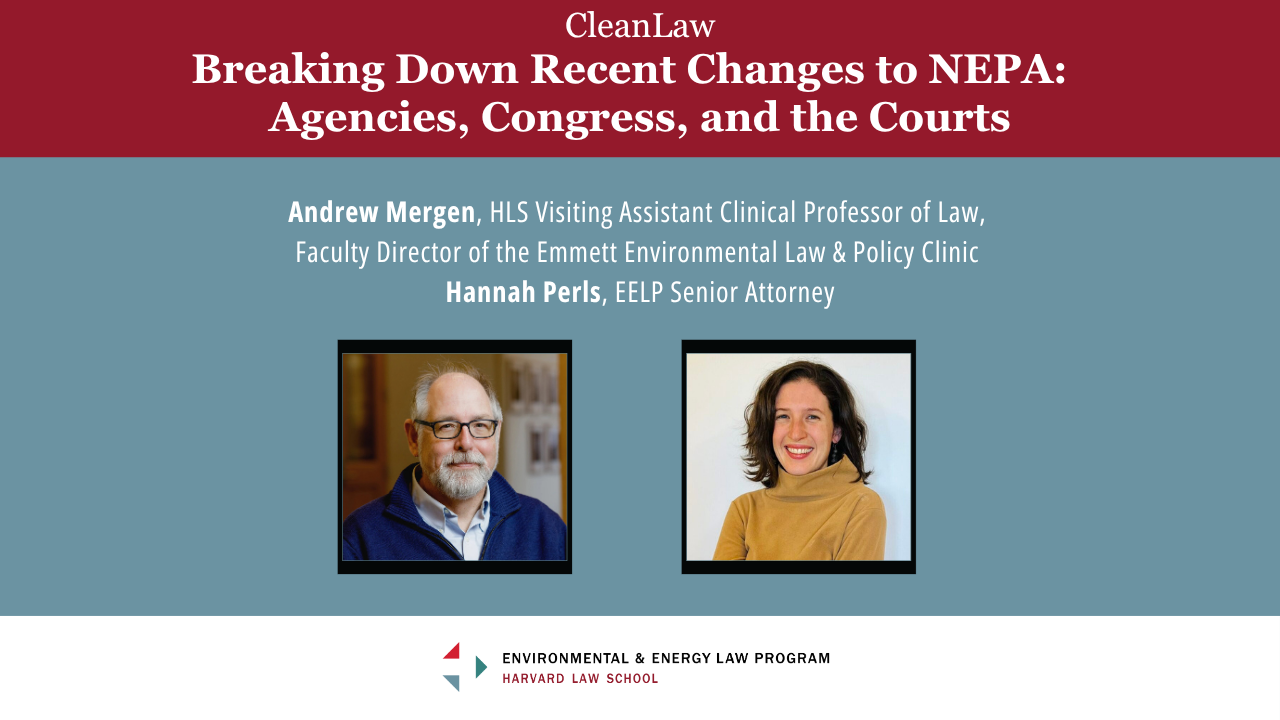
EELP attorney Hannah Perls speaks with Visiting Assistant Clinical Professor Andrew Mergen, faculty director of the Emmett Environmental Law & Policy Clinic at Harvard Law School, about the latest updates to the National Environmental Policy Act, including new agency implementing procedures, the Supreme Court’s recent opinion in Eagle County, and amendments included in the One Big Beautiful Bill recently passed by Congress. They also discuss what these changes mean in practice for project developers, impacted communities, and the environment.
Transcript
Hannah Perls:
Welcome to CleanLaw from the Environmental and Energy Law Program at Harvard Law School. I’m Hannah Perls, an attorney with EELP, and in this episode I speak with Professor Andrew Mergen, faculty director of the Emmett Environmental Law and Policy Clinic about the latest updates to the National Environmental Policy Act or NEPA, including new agency implementing procedures, the Supreme Court’s recent opinion in Eagle County, and amendments included in the One Big Beautiful Bill recently passed by Congress. We talk about what these changes mean in practice for project developers, impacted communities and the general public. Thanks, Andy, for doing this.
Andrew Mergen:
Oh, thank you.
Hannah Perls:
So I want to start with the basics. What does NEPA do and why does it matter?
Andrew Mergen:
Yeah, it’s such an important statute over the years, enacted in 1970 and probably the most influential environmental statute of all time. It’s a look before you leap statute, it says to the federal government, “Understand the environmental consequences of what you propose to do and inform the public and the decision maker about those processes.” It’s a procedural statute. It doesn’t require the best environmental decision, a very bad decision, and many have been made after very complete NEPA analyses. It’s a widely copied statute, both as mini-NEPAs in the states and internationally by foreign governments, by international lenders like the World Bank, Inter-American Development Bank, have adopted this framework of looking before you leap.
I think the most important part of the statute is both the look and the public disclosure, the information gathering and reporting parts of the statute. It is a statute that encourages and engages the public, historically, to participate in decision-making. It proceeds under an assumption then members of the public may know things that the decision makers don’t that they may need to know, that they may have perspectives. And in that sense, I think historically it’s been a very democratic statute. We’ll talk a little bit about public participation in a second. But at the core, look before you leap, inform the decision maker, inform the public.
Hannah Perls:
And I should have mentioned before we really jumped right in is you have maybe some of the most extensive experience litigating and examining NEPA than almost anyone else in the country.
Andrew Mergen:
Yeah, I mean for a very long time I was a DOJ attorney in the Environment of Natural Resources Division where I defended agency NEPA decisions for a very long time. I was in ENRD for 33 years. For 20 of those years I was a supervisor. So even if I didn’t directly work on a case, I generally reviewed the majority of NEPA cases in the courts of appeals. Before I went to law school, after college, I worked for the Bureau of Land Management as an assistant to an area archeologist in Lander, Wyoming. And that was an experience where I got to see how NEPA is implemented by a land management agency on the ground.
In some ways, you would think that my very long experience with NEPA would make me cynical because there are a lot of NEPA cynics out there, that partially explains how we got to where we are today, which we’re going to talk about in a second. And I understand a lot of that, right? I saw major decisions slowed down. I saw a lot of redundancy, overly long documents. But overall, I’m not cynical about the statute because it was exciting when I worked for BLM to go out and report on the conditions on the ground, the locations of Native American cultural heritage, sort of what was going on the ground and putting that into a document that was going to inform a decision. That seemed important to me.
And overall, in terms of seeing the dedication and hard work done by the folks in the federal government who prepare these documents, that was also very encouraging. These documents are not written by lawyers. Sometimes they’re written by consultants, and we can talk about that as well. But in the land management space where a lot of NEPA occurs, they tend to be written by biologists and archeologists and range specialists. They’re writing the pieces and they’re doing it in good faith. And the documents aren’t perfect, but we’re learning something important as they assemble that expertise and that knowledge. And then we have the public able to weigh in, which I think is a very, very democratic value and very important. So a lot of experience with NEPA, but not a cynic.
Hannah Perls:
Well, I think you’ve alluded to this, but as someone who is very familiar with both the implementation and interpretation of NEPA, you know very well when we think about other classic environmental laws like the Clean Air Act, Clean Water Act, NEPA is shockingly short and this leaves a lot of room for the courts and agencies to fill in the gaps of what implementation should look like. So can you talk a bit about how the courts in particular have shaped the meaning and implementation of NEPA?
Andrew Mergen:
Yeah, this is a really important point because a lot of times, as you noted, when we’re in the environmental realm there seems to be a lot of detail in the statutes. We talk about NPDES permits and best available control technologies, and there’s all of this detail, and NEPA is a very short statute. It was a dramatic departure from what had gone before. I mean, it is really an ambitious but modest, in terms of overall length, statute, right? We’re going to try to make good decisions, we’re going to try to incorporate the environment into decision making, but there’s not a lot there.
And so early on, the courts played an important role in sort of filling NEPA out. So the statute is enacted in 1970, and we’re going to talk a little bit about the regulatory regime, but we don’t have regulations until 1978. The statute creates the Council on Environmental Quality, which sort of manages NEPA. And that’s a statutory thing, the CEQ, Council on Environmental Quality is created by the statute, but the statute is silent about regulations.
So in 1977, Jimmy Carter says, “You can have regulations,” in an executive order, and CEQ starts to produce regulations in 1978. Before that there’s no regulations, there’s guidance. But guidance doesn’t necessarily bind agencies and the courts are filling in the details in this way regard maybe NEPA is like the Sherman Antitrust Act. There’s a lot of work for the courts to do. And so the courts have played a really important role in defining what is adequate for an environmental impact statement or what is adequate for an environmental assessment or what is an adequate range of alternatives. And each of these cases, we can talk about facts in a second too, they’re very fact dependent, right? They develop in the context of a specific project on a specific landscape in a specific context, and the courts are dealing with all of that first in the absence of regulations.
Then in 1978, we have regulations and those regulations are on the books until the first Trump administration proceeds to rewrite them. So we’re talking about from ’78 to 2020. The regulations don’t in some ways keep up with the change. In times. CEQ is very reluctant to reopen the regulations, for whatever reason, but we know that rule making is time and energy intensive. They fill in some of the gaps with guidance, but guidance isn’t quite the same as regulations. My point is from 1970 to ’78, courts are doing a lot of work because there are no regulations, so a run of eight years. And then from ’78 to basically 2020, the courts are continuing to respond as the regulatory regime doesn’t keep up. And so we have a very complete common law of NEPA, and that’s a really important thing to keep in mind as we look towards the future.
I just want to go back to CEQ for a second, right? First I want you to understand what this office is. It’s a very small office. Traditionally it’s been located in a townhouse in Lafayette Park that you can step out and see the White House, but it’s a townhouse and there’s not a lot of room in that townhouse and the staff has always been very, very small. And yet, they have to administer the statute which touches on so many things. And so they came up with the regulations and they proceed to track sort of what’s going on in the courts. But it’s hard for them to keep up with what is going on because they’re small. It’s a small group of people trying to make sure, looking at what the agencies are doing, each of the agencies is coming up with their own set of NEPA regulations consistent with the CEQ regulations from 1978. So there was a very important role managing a very big statute, but they have a very modest group of people to do that.
Hannah Perls:
I think that’s really helpful just to actually think about the bodies who have to make this process work. And you had mentioned when you were working at BLM, the scientists and the folks who are ground truthing, what actually these projects are going to accomplish. And so I think having that spectrum is really helpful as we now dive into what has been happening in the last few months. So I’m going to walk through a very quick timeline of the recent changes to NEPA under the second Trump administration. But if folks want a more detailed timeline, we do have our Regulatory Tracker page, which we’ll link to in the show notes. So in his first week in office, President Trump revoked that 1977 order, that you mentioned, from President Jimmy Carter saying that CEQ can issue binding rules. So that order is now gone. So one month later, CEQ then unilaterally withdrew all of its prior rules, the 1978 rule, the 2020 rule issued under the first Trump administration and two rules that were issued under President Biden. So now there are no CEQ NEPA rules and allegedly no CEQ rulemaking authority.
And then President Trump told federal agencies to update their NEPA rules, so these are other federal agencies that aren’t CEQ, to update those rules within one year. And CEQ suggested that those updates should be based on the 2020 rules finalized under the first Trump administration. And then CEQ also put out a template for agencies to use to update those regulations. And we also have an analysis breaking down what’s in that template and how it actually differs from the 2020 rules. There are lots of new provisions that were suggested and we can link to that in the show notes as well.
So we do have a lot happening in the last four months. So I just want to ask you to break this down a little bit. Can you talk about the legal and practical significance of CEQ withdrawing all of its NEPA rules in this way, and especially this argument that CEQ lacks rulemaking authority under NEPA? Where does that come from and is there consensus that this represents the current state of the law?
Andrew Mergen:
Yeah, I want to talk about two pieces of the events that you laid out. The first is the rescission by the Trump administration of the 1977 Carter executive order that purported to give CEQ the authority to promulgate regulations. So as we discussed, I’ve litigated NEPA cases for a long time, and we have always understood that there was… in the federal government where I was previously, we always understood that there was an issue with regard to the CEQ regulations. Because normally how do regulations come into being? Congress delegates to an agency the authority to issue regulations, and here that didn’t happen, right? Instead, the president said to his agency, CEQ, “Promulgate regulations.” And so that’s the rub.
And Judge Randolph on the DC Circuit who litigated at the Department of Justice in the Solicitor General’s Office, many of the early NEPA cases was very, very aware of this issue. And so it was not infrequent when you were arguing before Judge Randolph in a NEPA case, he would say, “Do you think that these regulations are legitimate, because they were promulgated by virtue of an executive order?” And good government lawyers knew to anticipate that question and to say, “Congress has again and again indicated that it understands CEQ to have this authority. So we think, yes, these regs are proper and we think Congress has told everyone that this regulatory regime is proper.”
And if Harris had won, I think that the government would have appealed on this issue, probably a case in the 8th Circuit where the court also held that CEQ was without this authority and argued that the regulations were legit. The Trump administration had, I don’t want to coin a phrase, with NEPA, came to a fork in the road following this litigation. They could either double down on what they did in Trump one, which is go with their regulations, their view of the way NEPA should work and stick to a regulatory regime. Or they could sort of blow the whole thing up by saying, “There’s no authority for this regulatory regime.”
There are significant consequences with which route you go, whether you take door A or take door B. They decided to sort of blow the whole thing up and say, “Can’t have regulations. We’re going to direct to agencies to come up with their own sort of sets of rules here.” And the one downside of that approach is that it creates uncertainty. It introduces a whole new sort of landscape for NEPA. Whereas if they had just said, “We’re going to go back to the rules that we worked very hard on in 2020” which a lot of people didn’t like, but they seemed happy with.
Now the problem for them with doing that is they’d have to rescind rules, then they would have to republish rules, they would take comments. That would take a long time. The plus side of doing rules is rules have a more sort of durability. Courts take them more seriously. We’re going to talk about a case in a second where Justice Kavanaugh said agencies get a lot of deference and rules help agencies get deference. So if they’ve gone the rule route, there’d have been maybe more stability on the landscape, but they decided instead to blow the whole thing up, which I think is what we’re going to talk about next.
Hannah Perls:
Yes, absolutely. And I think there’s something implicit that we’re both assuming, but I just want to name it, which is when you have one central agency like CEQ issuing one set of rules for the whole federal family on how these processes should work, it not just creates certainty for agencies, but for people who actually need to move projects through this process. So whether or not you like the rules, I think it at least tells you what the rules are.
And I think what we’re seeing now, and we’re going to talk about this is we are now seeing lots of different agencies issue their own rules that are effective immediately and they’re all kind of similar, but they’re also kind of different. And navigating that, I can say from personal experience, requires several lawyers who make this their full-time job. So we’ll get into that very, very soon. But you referenced Justice Kavanaugh, on the Supreme Court. So I now want to dive into another major development, which is of course Eagle County.
So the Supreme Court recently issued this major decision on NEPA, in this case, Eagle County. And we do have a write-up on Eagle County that we’ll link to in the show notes, but of course we’ll discuss it here. How does Eagle County potentially change NEPA reviews going forward? So the review of a particular major federal action and how does it potentially change agencys’ rules interpreting NEPA?
Andrew Mergen:
Yeah, so Eagle County is a case that arises in a context where there had been a lot of consternation and agitation, especially around two sorts of effects. One is effect on climate from agency actions, authorizations, and the other is effects on environmental justice communities as a result of agency actions and authorizations. Since the Clinton administration, there had been an executive order that told agencies that they needed to take into account the effects of their actions on environmental justice communities.
We haven’t mentioned it, but of course Trump also rescinded that executive order. Eagle County touches on both of these issues in a big way. Eagle County is a case about a rail line that is going to move oil from the Uinta Basin in Utah, ultimately to refineries along the Gulf. And there are both upstream and downstream effects that the environmental community argued that the authorizing agency, the Surface Transportation Board, needed to consider in its NEPA document. The upstream were increased well drilling in the Uinta Basin because there was this mode of transportation. If you built this train, there would be more oil development. More oil development means more greenhouse gases.
On the downstream side, you’re moving this kind of viscous sticky oil to refineries in the Gulf of Mexico where there are many environmental justice communities, many communities that have been burdened by the petroleum industry for many years, and you’re going to send more oil to be refined there and add to their burden. And the environmental litigants in Eagle County, which was a plaintiff in this case, argued that the environmental impact statement was inadequate for failing to take into account these upstream and downstream effects. There were a couple of arguments made as to why those effects could be ignored. Before I get to that, I do want to say that this issue, particularly the climate change issue, has been a big issue in the courts for the Biden administration inheriting a lot of oil and gas decisions from the Trump administration.
One of the first things that they did was issue a moratorium on oil and gas development and look at leasing decisions and say, “We think these leasing decisions are inadequate because they don’t fully disclose the climate change implications of these leasing decisions.” And that sort of put a target on this particular issue because it was becoming more and more important. What did NEPA require in terms of disclosing these greenhouse gases associated with oil and gas development?
So it wasn’t surprising, I think to anybody that the case went to the Supreme Court. So Justice Kavanaugh’s analysis has two pieces, and the first piece I want to talk about is things that seem remote in space and time. And Kavanaugh focuses on the proposed action, and here it’s the authorization of the rail line. And he says that other proposed actions that might be reasonably foreseeable but are distant in time and space are off limits, right? And that’s not always the way that NEPA has been implemented in the past.
Now, Kavanaugh understands that there may be impacts from the proposal that are significant environmental impacts that are distant in time and space, like runoff from a project, erosion, pollution, things like that that carry far downstream. He seems to admit that those things are captured. But one of the things that he says is that these things, the upstream oil and gas development and the downstream refining, are really separate proposals. And not being part of this proposal and being geographically and time, big separation here, they’re out of the picture.
And one of the things that has disturbed me about this analysis, I understand what he’s driving at. And in terms of the upstream, for sure there’s going to be NEPA associated with… A lot of this oil and gas drilling is actually on an Indian reservation, and there will be NEPA associated with that because those are trust lands. So there is going to be a NEPA look for that. Now, the refining, unless I’m missing something, there’s really no NEPA analysis for the refining operations themselves. Most of what EPA has regulatory authority over is exempt from NEPA. So there is a sort of assumption that NEPA will somehow capture these other things, I think inherent in his decision that I just think is at least partially wrong.
Hannah Perls:
I think this is actually a great transition to talk now about other agencies’ NEPA authority. So over the 4th of July holiday, several agencies including Transportation, Energy, Interior, FERC, Agriculture, and Defense, all issued at the same time updated NEPA rules. And these are all as final rules or interim final rules. And in almost all cases except for FERC, these changes are effective immediately. And several agencies are deleting large portions of their rules and now plan to rely heavily on guidance, which they’re calling operating procedures, in order to govern their NEPA processes.
So I want to talk about a couple of things. One, why does this switch to guidance matter and what did the content of these updates tell us about interagency coordination on NEPA going forward and what types of effects that people are going to be looking at?
Andrew Mergen:
Yeah, these are excellent questions. I think a lot of us were surprised by the developments over the 4th of July holiday, in that there doesn’t seem to be any sort of central command. It’s sort of like the command to the agencies is choose your own adventure in a way, meaning that you can do rules or you can do guidance, right? And as we talked about a little bit earlier, guidance is generally understood in the administrative law world to be not very resolute. It’s not something that courts are inclined to defer to. It’s something that agencies often depart from, but it’s easy to get out, right? Whereas rules are harder to promulgate.
And these agencies didn’t act in a coordinated manner, even though, historically, agency proposals or authorizations frequently implement the domains of multiple agencies. So you could have a case, you could have a natural gas pipeline that FERC has a piece of, it crosses jurisdictional waters of the United States under the authority of the Corps of Engineers, and maybe it’s in the habitat of an endangered species under the domain of the Department of Interior. And you don’t have CEQ playing that central role it has historically played as sort of saying, “This is the ceiling. This is the floor. This is what we need you to do. You could do more in terms of setting your own ceiling, but these are our expectations.”
And so this seems like… and you alluded to it before, it seems like a recipe for instability that ill serves both environmental interests who are concerned about the environmental effects of these decisions, but also agency proponents like people who want to build transmission lines or gas lines or seek authorization for oil and gas operations. This complicates things, and it’s hard to understand how the administration thinks this is going to play out. I guess what we can feel more confident about is that they anticipate a very constrained NEPA analysis. We know that they are leaning hard into the Seven Counties decision, so they really don’t want to hear anything about climate. We know they don’t want to hear anything about EJ.
They are, I think, and this may be one of the most disturbing aspects of the overall trend we’re seeing which is really, really cutting out public participation. And for sure public participation has been a difficult part of the process, right? When the State Department did an EIS for the Keystone Pipeline, the pipeline that was proposed to move oil from the tar sands of Alberta to American refineries, well over a million comments come in. We live in a world where it’s easy to do comments. A lot of those comments may just be postcards, but you can get an enormous amount of them and then you have to respond to all of those comments. You have to look at them, often you have to hire consultants to do that. So the public participation has been sort of a drain on agency resources in a big way.
On the other hand, cutting out this kind of participation, you’re not just cutting out the postcards, you’re cutting out comments from people in the community. For a lot of resource development, whether it’s oil and gas or rare earth minerals or just mining in general, if you were to put in a map of where Native American and Indigenous communities were located and where those resources were located, you would find considerable overlap.
We have not always done a great job, but we have understood for the last 30 plus years that it’s important to hear from affected communities, whether those communities or Native communities or just people in the neighborhood that their voices should be heard. And it’s very disturbing that one aspect, one through line in what all of these agencies are doing, not all to the same degree, but the through line is they’re cutting out public participation. And I really think, and we can come back to this idea, this is may be a big problem for the administration in the courts and in Congress down the line. And then the other piece of this is clearly the constraint on the effects, right? We’re going to lose a lot of things that agencies, reasonably foreseeable effects and impacts the agencies formally considered just dropped from the analysis.
Hannah Perls:
And I think one thing you mentioned on the public participation, a lot of these new updates are just that, they are new. These aren’t things that were revived from the 2020 rules. The 2020 rules had really robust public participation requirements. Not just options, but you had to, agencies were required to under the rules, really engaged the public throughout the process. And so that is completely gone, and that is something that was recommended by CEQ in that template that they put out in early April. And as I flagged, we have a table that compares so you can see what was in the template that’s new versus what was revived from earlier roles and that’ll be in the show notes.
I think there’s one other thing that I just want to flag for folks. One of the changes that we see throughout agency’s procedures is disaggregating major and federal in terms of what is a major federal action, and there’s a new monetary component in what is major. So for many of these procedures, agencies are saying that what they might do, we don’t see a concrete threshold, but they’re reserving the discretion to say if a project costs a certain amount of money or if this part of the project is a certain percentage of the overall project cost, we’re going to say that’s not major and is not just going to receive less NEPA review, but is exempt from NEPA review. So there’s this new introduction of cost as a way of saying, “Well, this is small and therefore insignificant.”
Andrew Mergen:
I told you early on that I’m not a skeptic, but there were certainly cases that were brought that were really difficult. And a lot of those cases had to do with farm loans or VA loans, things like that. If you provide loans to… Sometimes military bases are located in places with a lot of high ecological value or high biodiversity because military bases tend to be out in the hinterlands often. And savvy environmental groups would sue and say, “These VA loans for home buying are going to create a market for homes that is going to create more groundwater usage and that is going to harm riparian areas. And so before you do these loans, by the way, we need to see a robust NEPA analysis.”
I understand why those cases are brought, but they sort of ill serve the statute. It’s hard to explain to the public that seems somewhat speculative down the line, I’m sure people can argue about how precisely how speculative, but it seems of a different order than, “I’m going to build a ski resort,” or, “I’m going to build a dam.” So there had to be some line drawing here. So I think drawing lines about the financial monetary inputs is not necessarily a bad idea and other sort of little NEPAs do that in the state system. The trick is finding the right line, right?
Hannah Perls:
I think that’s really, really helpful. And something we talk about in the analysis in Eagle County is ways that these sort of unhelpful NEPA cases, if we can call them that, highlight a real gap in federal environmental law writ large. I think NEPA gets leaned on a lot to address concerns that aren’t addressed by the Clean Water Act, by the Clean Air Act, by these statutes that are decades old. And in particular, this idea that we’ve been talking about, which is cumulative impacts. We haven’t named it explicitly, but recognizing that we aren’t impacted by one pollutant at a time, one project at a time, we experience environmental pollution in the aggregate, and our laws are not designed to address that in any way. And NEPA is sort of the closest we can get. We sort of lean into the best version of these suits. The idea is we want the agencies to be thinking about the big picture, but unfortunately I think that pulls NEPA into a space that doesn’t belong.
Andrew Mergen:
Yeah, I completely agree with that point. And I would just say one other thing too, which is that I think we sometimes lose sight of the fact that the agencies are under constraints. There are laws that tell the Department of Interior to lease for oil and gas. In fact, the law says to offer leases four times a year. And so it becomes very hard at the end of the day to say, “Well, geez, if BLM just knew how devastating this was going to be the climate, they would stop doing it.” It’s awfully hard to do that when Congress has told you to offer leases. So the lift that NEPA performs in those leasing decisions is not go, no go, but is this the best place? Are we mitigating in the right way? And in that regard, I think NEPA does a lot of important work that we lose sight of.
But is NEPA by itself going to cause the agency to say, “No action alternative here, we’re not going to lease, when Congress has these expectations for us to do that”? No. And so NEPA critics say, the advocates, the environmentalists, just want to drive this out long enough that people walk away. And that’s happened a lot, right? There are big cases. I worked on the Atlantic Coast Pipeline case, very controversial pipeline case. It went to the Supreme Court, Atlantic Coast Pipeline won in the Supreme Court, and then they walked away from the pipeline.
Now, there’s still a fight about another pipeline there, right? There is demand somewhere for a pipeline but ACP walked away after all of that litigation and after all of the process. And so big win for the environmental community, but not necessarily a win for NEPA. A win for NEPA would be, “Did we do this in the best possible way for the environment knowing that unless FERC could say, ‘We’re not going to do it,’ was going to happen?”
Hannah Perls:
So up until now, we’ve been talking about the core of NEPA. We’ve been talking about the statute, the judge-made common law that’s built up around it and agencies’ own rules. One other thing the Trump administration has done is introduce a whole other body of guidance through the declaration of an energy emergency. And so a lot of the recent project approvals that we’ve seen go through with a very abbreviated NEPA analysis are subject actually to these emergency procedures.
So just as quick background, on his first day in office, President Trump issued this executive order declaring a national energy emergency. And we do have a podcast episode discussing that from April 30th. So we’ll link to that in the show notes. And several agencies since then, including the Department of the Interior, have issued what they’re calling alternative arrangements to expedite NEPA review, in particular of proposed fossil fuel and critical mineral development projects that are consistent with this declaration.
And so several projects have now moved through that process, including the expansion of a uranium and vanadium mine in San Juan, Utah, and also just recently the approval of a new surface open pit coal mine in Bryson Mountain in Tennessee, which is on private land, but of course subject to federal approvals. So if we look at the expansion of the uranium and vanadium mine, this was really unprecedented. BLM completed the environmental assessment, something that under the law can take up to a year. And they didn’t just complete the assessment but also approved the project in 11 days. And I want to ask, is there precedent for this? And what gets lost when you do that in 11 days? What are we not getting?
Andrew Mergen:
Yeah. So I want to talk about the precedent issue first, right? Because CEQ has always recognized a sort of an alternative arrangements regime. So this makes a lot of sense when you track what it has meant historically. The alternative arrangements is intended to deal with those circumstances where there is simply no time to do an NEPA analysis. So I’m going to talk to you briefly about my favorite alternative arrangements case. So the California condor, a magnificent bird, was down to a very small number of animals because of loss of habitat, because of lead poisoning. They’re essentially… it’s less than 20 animals in the wild. And there’s a considerable debate about what to do when you’re down to this many animals. And what Fish and Wildlife Service decided to do was to capture them all, bring them into captivity, breed them in captivity and reintroduce them.
Spoiler alert, that plan has worked by and large. There are now hundreds of condors. You can go see a wild condor. Fish and Wildlife Service took a gamble, they got sued by the Audubon Society. The courts let Fish and Wildlife Service do this, and we’re happy that there are condors. But NEPA applied to that action. They should have done NEPA before they took those condors into captivity, but there was no time. So they went to CEQ and they said, “Give us an exemption because of these circumstances.” And then CEQ works out something. They’re not off the hook. They’re like, “Go forth, capture your condors. Not easy, but go do it. And we should write something up and take a look at this action in something that’s like a NEPA document.” So maybe not the best example. I’ll give you another.
Hurricane Katrina, that’s for your younger listeners. There were earlier giant disasters, and Katrina was a huge one, right? And as a result of all of the damage, not just in New Orleans, but in the environs around New Orleans, lots of work had to be done. And where there were federal authorizations or federal actions, NEPA would’ve applied. But you don’t want to wait. If you’ve got to cut down trees to make something habitable, then you need to go ahead and go do that. And so CEQ says, “We’re blessing this. You don’t have to do NEPA before you take this action, but you need to take a look at what you’ve done and think about it and produce a document down the line.” So alternative arrangements have largely existed to deal with those sorts of time sensitive emergencies. So here the administration has taken a concept set up for a very particular set of facts, the, “We don’t have time.”
The administration is doing something entirely different here and what you’re losing, for sure, is what is baked into the statute. The NEPA is supposed to be done before there is an irreversible and irretrievable commitment of resources. Now they’re purporting to do it very quickly, but is it truly going to be adequate on that turnaround? Now, the Interior proposal, as I understand it, is an opt-in, right? It doesn’t apply to anything.
So if you’re going to develop this mine, you have to opt in to these procedures. And I think it’s going to be really interesting to track how many project proponents want to do that because we don’t quite understand the litigation risks of these activities at this point. I think these actions that they’ve taken so far are sort of testing the waters. And if people can get into court, this use of alternative arrangements may not be upheld, but clearly they’re attempting to test the waters. But if you were developing a pipeline, would you really want to go this route or would you want to take a different route in terms of hedging your bets that you’re going to be able to move forward down the line?
Hannah Perls:
Maybe that’s a good transition to talk about the recent amendments to NEPA. So as part of the One Big Beautiful Bill, which was signed also on July 4th, there was a provision that amended the statute. So can you talk a bit about what that provision does and how it’ll likely impact NEPA reviews and agency capacity going forward?
Andrew Mergen:
Yeah, so this is a pay-to-pay proposal. And I think basically if you are going to cover the cost, like 125% of the cost I think it is of the NEPA document, then the agency will commit to a timeframe for getting this done. So it’s a way to accelerate the NEPA process, and it’s a pay-to-pay sort of proposal. To me, that’s probably a safer bet than the alternative arrangements that Interior has put in place for authorizations under its authority, right? We’ll see how this plays out.
It’s a deeply cynical move in terms of the original spirit of NEPA, which was really intended to help people make good decisions. But it’s a move that is, I think, very much of this moment. Because after all, good NEPA depended on the work of federal employees, and you have a federal workforce that’s been gutted. So now you just sort of have this special line right now, this is the CLEAR of airports for NEPA. You pay a little extra, you get to move through the line faster. And it seems deeply cynical in terms of there is great value associated with developing the expertise on the ground. The people I worked with in Wyoming who were making decisions, helping to fill out NEPA documents on pipelines and grazing proposals and all of those sorts of things. You’re going to lose a lot with these sorts of proposals.
Hannah Perls:
So it really just becomes a check the box exercise?
Andrew Mergen:
That’s what we worry. Yeah.
Hannah Perls:
So we’ve covered a lot of ground and pointed people to a lot of different resources, but I think to conclude, I’d love to ask what are the most important things that you’re going to be watching for in the next couple of months?
Andrew Mergen:
So I want to go back to where we started, which is that this statute, which was a really bold experiment and now has been very copied around the world, and look before you leap, an informed decision-making in an informed public, the courts had a huge role in sort of defining it. Everyone knows this. Justice Kavanaugh refers to it in his decision. We understand that the courts have played a big role. And the question is now what happens in the courts? Do they continue to play a role or are they really shut out by the administration’s process?
And then the other big piece is what happens in Congress, because this statute was a really bold effort by Congress in 1969, 1970. They’re very mindful of how it works. Over the years when things got bogged down, they could wave a wand and let things go forward. And there’s a big push on the part of the permit reform crowd, the abundance crowd, to have Congress do something. And I think we should make sure that Congress moves forward in an informed way. I think Congress should take back the public participation. I think that’s going to be really important.
The criticisms in NEPA are often located in particular stories. “It took me this long to get this done,” or, “This pipeline sat around for 12 years and this court’s gumming up the works and it was never going to move forward.” There are those examples. And there are also countless examples of projects, infrastructure projects, that have gone forward without substantial delay, like major runways are put in at airports. There are always lawsuits about that, those runways get built. There are ways to manage, to provide public participation, have informed decision making and build infrastructure.
But when you cut out the public, I think the people who are going to hear the most from this are Congress. And so they need to proceed very carefully because I think when people say, “They’re going to build a new airport in my neighborhood and I’m going to be subjected to hundreds of flights,” it’s better to be able to say, “Well, you had a chance to talk about it. You had a chance to file your comments. You had a chance to be heard.” And maybe the project has changed, maybe there are sound barriers, maybe the airport’s relocated.
But when you don’t have those opportunities, people are going to be very, very angry, and those switchboards are going to light up. And this is the opportunity for Congress, I think, to sort of say, “You know what? There are things about NEPA that are really, really important, and one is including the public in those decisions.”
Hannah Perls:
Thank you so much for providing this sort of whirlwind flight through the latest NEPA changes. And, again, folks should stay tuned to our website, the Regulatory Tracker. We’re going to be continuing to put all of those updates there. But, Andy, thank you so much for joining us on CleanLaw again.
Andrew Mergen:
Thank you.