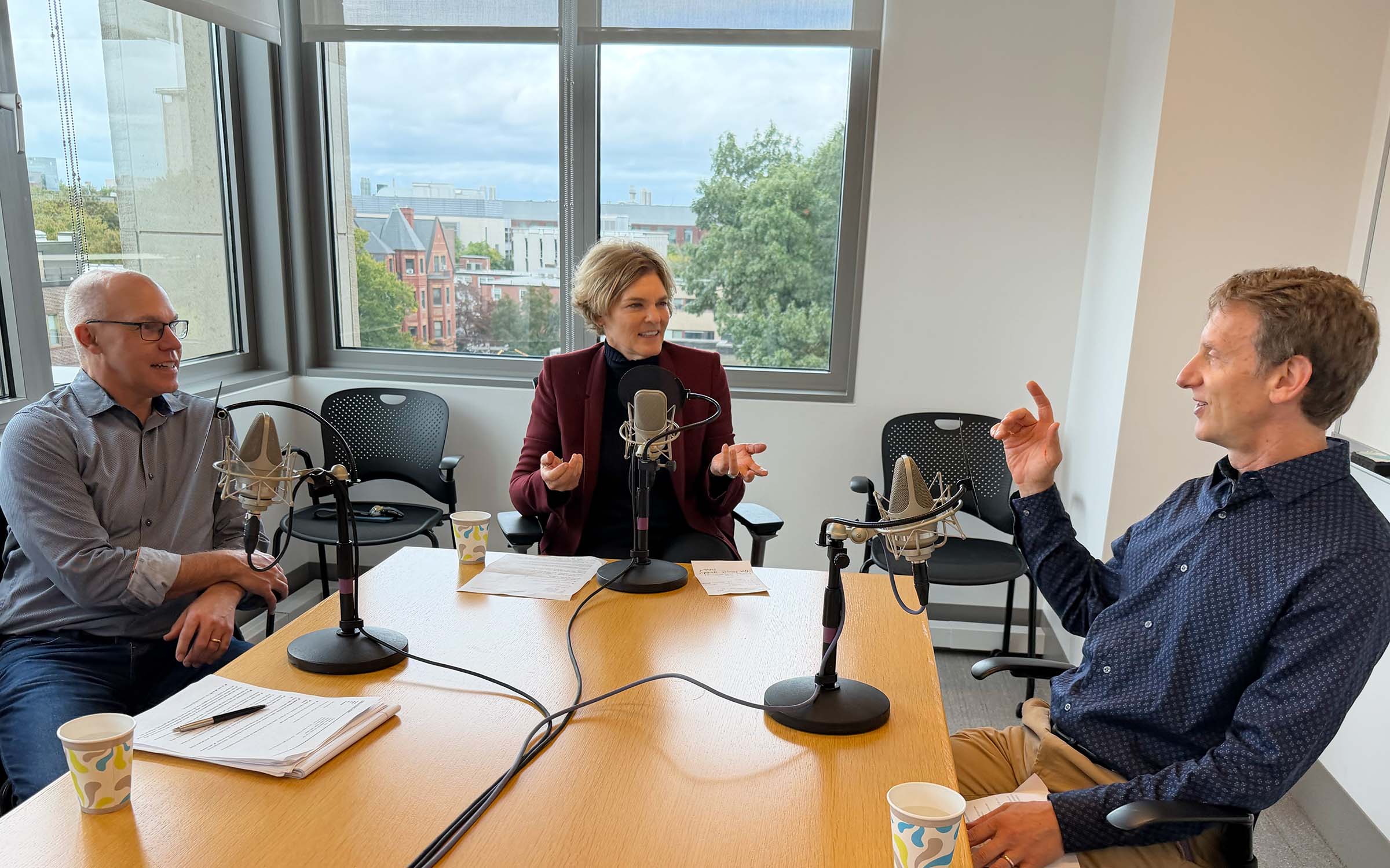
EELP founding director and Harvard Law professor Jody Freeman talks with Mike Toffel, a professor at Harvard Business School and faculty chair of the HBS Business and Environment Initiative, and Joe Aldy, a professor of the practice of environmental policy at Harvard Kennedy School. Jody, Mike, and Joe discuss the Salata Institute Corporate Climate Targets Database, a new tool they’ve developed to track climate commitments and emissions trends across Russell 3000 companies over the past 25 years. They discuss insights from the database, such as how companies respond when a target is set and how they adapt to shifting regulatory requirements. This free, interactive tool will help researchers evaluate which policies drive decarbonization and what durable, effective climate disclosure policy could look like at the federal level.
Links
Corporate Climate Targets Project dashboard
The Salata Institute’s Corporate Climate Targets Research Initiative
Transcript
Welcome to CleanLaw from the Environmental and Energy Law Program at Harvard Law School. In this episode, EELP founding director and Harvard Law Professor Jody Freeman talks with Mike Toffel, a professor at Harvard Business School and faculty chair of the HBS Business and Environment Initiative, and Joe Aldy, Professor of the Practice of Environmental Policy at the Harvard Kennedy School.
Jody, Mike, and Joe discuss the Salata Institute Corporate Climate Targets Database, a new tool they’ve developed to track climate commitments and emissions trends across Russell 3000 companies over the past 25 years. They share insights from the database like how companies respond to a set target and adapt to shifting regulatory requirements. This free interactive tool will help researchers evaluate which policies drive decarbonization and what durable, effective climate disclosure policy could look like at the federal level.
We hope you enjoy this podcast.
Jody Freeman:
Welcome to CleanLaw. I’m Jody Freeman, and today we have a very special episode with two of my best colleagues and good friends, Mike Toffel and Joe Aldy. Welcome guys.
Mike Toffel:
Thank you.
Joe Aldy:
Thanks for having us.
Jody Freeman:
Let me formally introduce you. Mike, you are the Senator John Heinz Professor of Environmental Management at Harvard Business School.
Mike Toffel:
Yes, I am.
Jody Freeman:
And Joe, you are the Teresa and John Heinz Professor of the Practice of Environmental Policy at the Kennedy School.
Joe Aldy:
Yes.
Jody Freeman:
So the topic for today is a project that the three of us have been involved in going on now three years, which concerns corporate commitments to reduce greenhouse gas emissions or set other kinds of targets or commit to net zero by a certain deadline. And we thought we would focus on this because the topic is of continuing importance and things are evolving in this space, and we have produced together a really important database. I’ll credit you guys with more of that than with me because you’ve got the background to produce it. But let’s talk about what this project involves, why we all got into it, and what we think we will be learning from it.
So just by way of background, before I ask Joe to give us more of an overview, this research project is part of our Salata Institute Research Cluster program. We have a climate institute here at the university and they fund research groups to do cross-disciplinary work. That is how we all got together at the Business School, the Law School and the Kennedy School. And so we’re part of that initiative, and this is a really important effort to understand what companies are committing to do and whether they’re actually implementing those commitments.
Joe, can you give us more of an overview of the work?
Joe Aldy:
Sure. Thanks, Jody. I think the important thing here is when we look at the voluntary corporate target landscape, it really raises important questions about business management, about law and regulation, and about public policy. That’s what attracted, I think, the scholars from the Law school, the Business school, and the Kennedy School to come together to work on this.
Now, in order to really understand what these voluntary corporate targets mean in practice, we need to actually better understand who has adopted these targets. So if we want to ask and address questions like are the emissions of companies with voluntary targets lower than other companies, do companies that take on targets start to inform and influence their peers, how do we think about these voluntary corporate targets interacting with existing public policies and regulations, we really need to have a comprehensive and complete assessment of who has adopted targets, what types of targets those are, and those who have not.
And so when we started this project, we kind of assessed the landscape, who’s actually compiled this kind of information. And there’s a number of really good resources out there, but none of them were really sufficient for our purposes. So that’s why we decided to create a new database, the Corporate Climate Targets Database that enables us to identify for the Russell 3000 companies, the largest publicly traded companies in the United States, who has adopted targets and of what form over 2000 to 2024. So we’re looking at the same sample of 3,000 companies over 25 years. This enables us to look consistently across different eras and it’s kind of climate policy and voluntary corporate action. It enables us to use a systematic framework for evaluating and categorizing these targets so we can really compare across companies in a way that isn’t all that easy when you read sustainability reports or annual reports where companies sometimes talk about their voluntary corporate targets.
But it gives us this, I think, both assessment right now, or at least as of 2024, the most recent year that we have evaluated, and this kind of change over time to be able to really understand the trajectory of voluntary corporate targets and be able to then start to explore really important questions about what kind of implications we think that has in the US energy economy, for our emissions, and for corporate practice.
Jody Freeman:
So I just want to put this in some context for people who don’t spend all their time thinking about what companies are committing to do on greenhouse gas emissions. The three of us each have a connection to this work and we’re interested in doing a project together. And so I want to back up a little bit and talk a little bit about why each of us wanted to do this project and why we want to do it together. Mike, can I ask you what drew you to it?
Mike Toffel:
Sure.
Jody Freeman:
And you have a background in this in your own work at HBS.
Mike Toffel:
Yeah, so my research has long been about the motivations of companies to engage in beyond-compliance behavior that’s both on the environmental front and also in labor management. So for example, on the labor side, we’re looking at companies that set up codes of conduct for their global supply chain that they then ask their suppliers to adhere to in regimes where they don’t have a regulatory enforcement mechanism that’s reliable. And so instead they send out either their own staff or third party auditors to go inspect to see are they actually adhering to these standards, which are loosely based on UN or developed country safety standards.
In the environment side, there’s a whole host of voluntary programs, everything from, for example, the ISO 14000 Environmental Management System standard, which is based on best practices of a variety of managerial steps you can take to get a handle on your environmental practices that some companies are opting into. And the question there is, does that actually make a difference? Similarly, the USEPA has a long history of not just mandatory requirements, but also voluntary programs where they’re seemingly allowing companies to opt in to these programs with either some soft benefits or some hard benefits. And so this fits broadly within that scheme of why are companies opting in for behaviors and does it actually make a difference? So that, coupled with my interest in transparency and disclosure and accountability, this project fit within those sweet spots.
Jody Freeman:
And Joe, what drew you to this?
Joe Aldy:
I have to admit, I was a skeptic at the beginning. As an economist, I think the way to address climate change and greenhouse gas emissions is through public policy and regulation that individual corporate firms don’t have an incentive to just do this voluntarily. Where we would see companies announcing these voluntary goals, I thought it was basically a PR campaign. I was sympathetic to concerns about greenwashing.
Having said that, as I spoke to more and more people actually working in these companies, you find out it’s not just the PR department, there’s real people making decisions, making investments inside the companies that’s reflecting real opportunity costs. So that’s making the economist and me think, “Well, wait, maybe I need to reassess my priors and think through why are they going about doing this?” And in having conversations with staff and business leaders, you start to learn there’s a number of benefits the company sees, the management sees, investors see, in taking action to address climate change.
And especially as we’ve been through this kind of back and forth in terms of public policy on climate change, it’s interesting to see more and more companies stepping forward and saying, “We’re going to adopt quantitative emission targets.” And then start to say, “Here are our transition plans to try to make this concrete, and here are the things we’re doing inside the company. Here’s what we may be doing to affect our supply chain.” You start to see real decisions, significant economic magnitudes in play reflecting voluntary action. So that then excited me to understand what’s going on here. How can we better assess what works, what doesn’t, how companies learn from each other, whether or not this can help push more aggressive actions to cut emissions down the line, how this interplays with the policy and legal frameworks that govern how we think about emissions in the US.
Jody Freeman:
Well, that’s a segue to me because I of course am interested in this because my work is in part on regulatory design and how rules help to incentivize behavior. And in the climate context, the question is, do we have rules that are helping to drive these so-called voluntary commitments? And remember when we started this way back, feels a long time ago, in 2022, we proposed this to our Salata Institute as a research project. We were right in the middle of a surge of these commitments from companies to take action, whether it was energy intensity commitments or GHG reduction commitments or whatever it was, or even the beginning of net-zero planning, that was happening in anticipation of a Securities and Exchange Commission rule that was going to require and did in fact require disclosure of at least scope one and two emissions.
Now, the fate of that rule has been, of course, to be blocked in the courts first and now reversed by the Trump administration. But at the time, the thinking was, okay, there’s a lot of voluntary commitment going on, but maybe it is all in anticipation of being regulated. And at the same time, we saw California begin to develop their own regulations on climate-related financial risk and disclosures and so on. So I come to it from this interest as a lawyer and legal regulatory designer thinking, “Okay, how much of what we’re seeing and what we were seeing from, say, that surge in 2019 or so to 2022, how much of that was about anticipating regulation and how much of it would happen even without the regulation?” And there’s of course state policy driving some of this too. So that was interesting to me.
And Joe, you and I worked back in the day in the Obama White House on energy and climate issues, and we think a lot about public policy design, and so how could we design disclosure rules that might interact with these voluntary commitments and not derail them, but encourage them. And the very last reason why I’m so interested is I’ve spent some time in and around the private sector and on a board doing advisory work for a sovereign wealth fund and watching from the inside how what you said is right, that there is real work being done in companies on this and they’re serious about it. Now, whether it will manifest in the commitments being implemented and result in emissions reductions, open question, but there is real work. And you said they’re committing resources, so what is going on where they’re making these commitments?
So the three of us together coming at it for all these reasons embarked on it. And the production of this database is a heroic achievement, you, Joe and Mike, with your teams of research assistants and fellows. Now the lawyers helped shape the database, but you did the econometric work to produce it. I get to use that word, econometric. I always love to use that word. And I want you guys to explain it because the database itself now, the Russell 3000 set of companies you described, is a gem and it’s going to be publicly available and usable for people who want to work with it. So we need to hear a little more about it.
Joe, can you tell us a little bit about how it was created and what it does?
Joe Aldy:
Right. So we’ve constructed this database for the Russell 3000 companies. So these are the 3,000 largest publicly-traded companies in America. It’s about 98% of the public equity market. So it’s covering the vast majority of public companies in America. We look over 25 years. We took as our starting point in collecting information about these companies over 2000 to 2024 that how they communicate in their public documents. It’s what the managers want their investors to know, what they want the media to know, what they may want policymakers to know. It’s the documents they put out in the public domain. So we focus on that and we say, if you are communicating about a climate or climate related target in your annual report, your sustainability report, your website, press releases, that then serves as a basis for what we would then catalog as a climate target in our database. So the targets need to be forward-looking. They need to be very clear about what the goal is. Is it an improvement in emissions intensity, a reduction in your absolute or mass-based emissions? Is it to achieve net-zero or absolute zero emissions by some specified year?
We track what scope of emissions is scope 1, scope 2, or scope 3 that it covers, et cetera. But by taking everything they put in the public domain as our screen, we’re able to assess everybody who has targets. But within the Russell 3000, importantly, I think we’re also identifying those companies that for a long time don’t have targets and some companies that have never taken on targets because we think at the end of the day, to really learn what’s going on with these voluntary corporate targets, we need to study both those who have targets and those that do not. So we had a small army of RAs go through-
Jody Freeman:
Yeah. I want to applaud Harvard Business School and Kennedy School and Law School RAs. Amazing on this project.
Joe Aldy:
Yeah. So we had more than two dozen RAs, several full-time research staff as well, leading this effort, compiling this information, doing a number of stages of quality control to go through all the documents and actually then produce line by line the database by hand as they’re taking information out of these public domain documents.
Jody Freeman:
Just to be clear, this is 25 years of 3,000 companies, sustainability reports and other-
Joe Aldy:
And annual reports, looking at their websites, looking at their press releases.
Jody Freeman:
And we didn’t just stick an LLM on this, meaning a model.
Joe Aldy:
No, but we did that at the end.
Jody Freeman:
To quality control?
Joe Aldy:
For part of our quality control. So the thing is we’ve taken all those public domain documents and we’ve maintained that corpus of files electronically that we can then use the LLM, train the LLM, produce a parallel database as a way to check what the humans do. And then our team does a quality control whenever there appears to be a disagreement between the humans and the machines. So that’s how we’ve gone about doing that.
In addition, we took for each company in our database, we emailed a representative of that company this past summer and saying, “Here’s the excerpt of our database that applies to your company. Let us know if we should update anything that we have here.” And so gave them an opportunity to follow up with us on that as well. So it is an extensive amount of work documenting all this. It is different than what we see in other databases that are out there. Some are survey based and there may be risks that you send out a survey to a company and they don’t reply or they don’t reply some years and they reply in others, or you don’t survey all the companies that have targets.
It’s different than other databases where you say, “Hey, I’ve taken on a target that meets certain kinds of standards.” So like the science-based targets initiative, really important in creating a platform for companies that they work with to be very serious in developing a plan and ambitious goals for reducing their emissions. So that’s a really important resource, but it’s only on a small set of the most ambitious companies, and we want to learn from all different types of companies, including those that don’t have targets. So that’s why in the end we decided we’re going to take this approach. We’re not going to rely on the existing inventory of ambitious targets or the survey-based work like what CDP, the former Carbon Disclosure Project has done, which has been a great resource for more than two decades. But we just found as we were digging in more and more in that it wasn’t capturing the full set of activity among these companies in America.
Jody Freeman:
So this is one of the big ahas, which is that unbeknownst to us, CDP, which as you said, does good work and has been keeping track of corporate commitments, really has only captured part of them and what they have done, plus companies they have missed that we have captured. And so if you add it all together, we’ve got the best coverage that we know about. Is that fair to say?
I’m going to ask Mike to term it.
Mike Toffel:
Yeah. In the US, let’s just be clear about that.
Jody Freeman:
Okay.
Mike Toffel:
So Russell 3000 is 98% of the US public equities market. CDP, to their credit, they have a global view. So they’ve been surveying companies in Japan and in Europe and elsewhere for many, many years. And so if you’re interested in emissions or targets that are voluntarily responded to their survey in those places, for sure you want to use CDP or other resources. We are just a US focus. But I think within the US focus, yes. And we’ve compared our data to CDP and to science-based targets to look to see any companies that disclosed to CDP that we had not seen disclosed. We took an extra look at their websites and, in most cases, then found publicly available information.
I should say one of the other reasons why we focused so intensely on just publicly available information is because from the get-go in creating this database, we knew we wanted to make it a publicly accessible resource. And so we didn’t want to get in a situation where we were taking data from licensed databases, like you can subscribe to CDP and get access to their data, but then we can’t put that on our database and make it available for free. So we were, from the very beginning, wanted to create this public good so that researchers well beyond the walls of Harvard could work on these questions that this database sets you up to do. But that required us to look carefully only at external for all the reasons that Joe said, but also this sort of license reason.
Jody Freeman:
Okay, good. So this covers the how and the why of the construction of the database and also gives folks a sense of how it differs from what was out there previously. I guess what I want to ask about now is what do we think? What does the database show us at the initial hit to somebody who may not be steeped in this, may not even work with databases regularly? What would jump out as something we did not know about before? I’ll have you start, Mike, and then Joe, you can chime in.
Mike Toffel:
Yeah, so Joe has a good sense of some of the stats on that, but I’ll just talk from the beginning about conceptually.
So the two questions that this data allows us to explore is one, what are the precursors of choosing to create such a commitment? And so larger companies or smaller companies, companies headquartered in blue states versus red states, CEOs that have MBAs versus not MBAs, all those types of questions about the precursors.
And then the second main question is, well, if we compare those who have adopted these targets to a similar set of firms, same industry, roughly the same size and so on, do those who have set targets actually then reduce their emissions more aggressively than those who don’t? Those are the big picture questions.
The step in the middle here is also there’s incredible variation in targets. So you and Joe have both been alluding to science-based targets or net-zero targets. So we came up with six categories after looking at all the mass. And one of the biggest surprises to me was our RA team kept coming back to us with, “Well, what about this target or what about this target?” Companies that have targets to procure a growing proportion of sustainable aviation fuel is a target.
Jody Freeman:
That’s a very specific target.
Mike Toffel:
Exactly. And so there are a million different types of targets here. We have 19,000 targets in our database and we had to figure out what’s the right typology. And so of course that was a creation of the database. But now that we have the typology, we can also use research questions to say, well, for example, those that have shorter-term horizon targets, those that are saying we’re going to meet a target within 10 years versus the soonest would be 30 years, do those companies differ in their emissions’ trajectory subsequent to choosing a target? So we can use all this heterogeneity in opening up a whole bunch of additional research questions either on the adoption, who sets more aggressive targets versus less aggressive targets, or on the consequences of those targets.
Jody Freeman:
So just practically speaking, we have a variety of companies, like you said, big and small in different parts of the economy, different sectors. There’s manufacturing, there’s utilities, there are a whole variety of companies. And now you’re saying they’re making a whole variety of commitments to either reduce emissions or engage in planning to achieve net-zero emissions by a deadline or and so on and so on. So the heterogeneity you’re talking about makes this very complex. And this has all been captured in an incredible tool that is actually available to the public on the Salata Institute website. So we should say that because you can go there and you can use the dropdowns and see that you can look by company, by sector, by size of the company, and you can check out who has committed to what on what deadline and look at all the variation there. So that’s a really useful tool. And of course, researchers may want to take advantage of the raw data, which we also made available.
Joe, can you help us though understand some of the key initial takeaways that you get if you look at this?
Joe Aldy:
Right. So the first thing that I think jumps out to you is that about one in two companies in the Russell 3000 at some point has adopted a climate-related target, either to reduce their emissions, to go to net-zero, or what we identify as climate-related targets, that may be an energy efficiency goal, a renewable power procurement goal, a vehicle electrification goal, et cetera. So we’ve got a lot of activity across these companies.
Having said that, what’s interesting is that while there has been steady growth and in fact an acceleration starting probably around 2018, 2019 in companies voluntarily adopting targets, by about 2023, we see that plateauing. And actually in the last year of our database, ’24, we actually see fewer firms with active targets than the year before.
Jody Freeman:
So when you see this visually, it’s like the graph goes sharply up to 2019 and then it plateaus and we’re now seeing a little fall off?
Joe Aldy:
Yeah. So you’re seeing a big growth from 2019 to about ’21, ’22. ’22 to ’23 is a small increase. And then ’23 to ’24, we have about a hundred fewer firms with active targets. Now, what’s interesting about that is that roughly a hundred fewer firms, it’s about 200 firms that no longer have active targets on our database and a hundred firms that have newly adopted targets in ’24. So about this kind of heterogeneity, part of it’s trying to understand why at the same time do we see some companies moving away from targets, But others opting for the first time to adopt targets. So that’s sort of one thing.
We kind of anticipated with this swing in the politics of climate and climate policy in ’25, and we saw in the press, companies publicly walking away. We know some companies quietly walk away from the targets, but the fact that we saw some of this occurring in 2024 is something that we’re going to be spending some time digging into to better understand as well.
I think the thing that jumps out when you look at the whole database and why there’s value being able to look out across time and not just having the most recent snapshot is seeing how often companies update their targets sort of midstream. So between their announcement year when they said we’re going to set a target for some future target year, but before they get to the target year, they update that target. Almost 80% of the time, firms are changing their targets before they get to the target year.
Jody Freeman:
Which direction?
Joe Aldy:
Both!
So sometimes they’re keeping it just as ambitious in terms of the annual decarbonization rate that would be required to hit the target, even if they’re changing either the target year or they’re changing the actual quantity goal that they’re trying to go for. Some are relaxing the target, so they may be keeping the same quantity goal, but pushing it a few years out. Sometimes it’s because they’ve hit their goal really early and they say, “We just need a completely new goal.” So you see this happening and going in both directions, which again, this kind of heterogeneity creates a rich opportunity to really study and understand what may be associated or what may be the factors that we would say could help contribute to meeting the goal early, causing you to go more ambitious with a new goal versus those that are wanting to sort of push off a little bit the day when they have to admit they haven’t hit their goal, because we certainly see that in our data as well where companies have failed to meet their goals.
So I think trying to decompose that is something that we’re also looking forward to doing this.
Jody Freeman:
I mean, we might have hypotheses about this. We might say, “Well, there’s something in the political environment that’s making some of these companies walk away or go quiet.” But based on what we’ve collected so far, we don’t have an explanation. We can’t say anything about causation. And we really can’t say much about correlation either. We’ve just got the beginning point. Is that a fair thing to say or do you think there’s something more that the data captures?
Mike Toffel:
Yeah, we can begin to unpack the correlations. And so we’ve two projects underway, one with a doctoral student and one with a postdoc. One of them is looking at emission trends across the whole Russell 3000. And that study is finding that if you develop what are matched samples, so for everyone who adopted a target, you find someone who didn’t adopt a target but looks similar to them, and then you trace their emissions trajectory over time, we are finding within that match set that those who set targets actually do reduce emissions or emissions intensity in that case more rapidly than those that didn’t.
Jody Freeman:
And I think the figure that we found is something like 20% or 21% where-
Mike Toffel:
That’s right.
Jody Freeman:
… we’re controlling for everything else.
Mike Toffel:
We’re trying to control everything. Yeah.
Jody Freeman:
Okay. And the idea is the best explanation for why these emissions are dropping is the fact that they’ve adopted a target. I’m overstating it. He’s looking at me skeptically.
Mike Toffel:
Right. Well, you asked me to talk about what we can and can’t and can’t say.
Jody Freeman:
Yeah, exactly.
Mike Toffel:
So I’m not sure we can say that. I think we simply can say those with targets are reducing their emissions intensity faster than those without within that sample.
Jody Freeman:
So there might be a correlation we can claim but not causation?
Mike Toffel:
That’s right. And one way to think about that is that perhaps the companies that already knew they were going to make the investments or the divestments in order to reduce, they were the ones seeking to get some credit for it. And so why not say we’re going to reduce and then they actually do reduce? So that’s not causal, it’s correlation. It’s still important because it gives us some insight as to whether on average those who fly the flag of a commitment are likely to reduce their emissions. By that standard, we say yes, so far. And then we are able to break that out.
But then the other sector where Joe’s been more closely working on is the electricity sector. And there we’re able to take advantage of government mandated information at the electric utility level, which goes down to even the plant level and even the generator unit level to see for the electricity for in that sector. We can look, do those who have targets, do they reduce more than those that don’t have targets? And we can dive in much more microscale.
And so perhaps Joe, you want to say a few words about that?
Joe Aldy:
Sure. So the great thing about being able to use the power plant data is that we’re really able to understand in a sense what may be the mechanism or the strategy that the utility uses to reduce its emissions. Are they expanding the generating capacity in renewables and perhaps retiring some of their fossil plants? Are they improving the generating efficiency of their fossil plants? Are they dispatching more from lower carbon units than higher carbon units? So using a sort of similar kind of statistical strategy that Mike just described when looking at firms, we’re able to look at generating units and look at those units for the utilities that have adopted targets, compare that with the utilities that have not adopted targets that look similar, and find that after a few years of adopting a target, the fossil plants have lower emissions.
So we’re able to see that it is, for the most part, it’s reducing generation from them. There’s a little bit improvement in efficiency, but you can only improve the boiler efficiency so much in a coal plant. It’s a lot easier to reduce missions from a coal plant by not running it. So we see those kinds of changes occurring there.
Jody Freeman:
Can I ask you one more thing? This is pretty granular data and it’s partly driven by the fact… I mean the utility sector is highly regulated, so we get much more data from the Clean Air Act and other sources. Is that correct?
Joe Aldy:
Right. So what we have here are data for the utilities on their CO2 emissions, carbon dioxide emissions that comes from the EPA. These utilities have had to collect this information under the 1990 Clean Air Act Amendments that created Title IV, the Acid Rain Provisions of the Clean Air Act. We also have, because they are regulated, the Energy Information Administration collects a lot of information from all these generators that tells us how much power they’re generating, how much fuel they’re using, when they’re making changes and investment in their facility. So it enables us to really look unit by unit. So it enables us to go one step beyond just do you have a goal for the firm and what’s the overall emissions for the firm? But really being able to look and see what is changing in what they do with their capital, with their processes that enable them to reduce their emissions relative to those other companies that are not.
Jody Freeman:
So we’re going to have much more visibility into the utility sector than others, at least so far. And there’s one more takeaway I wanted to cover because again, when people come to the database and they may not be experienced working with it, what do we want them to see? There’s another insight, which is that if you’re big, you make commitments.
Joe, can you speak to that?
Joe Aldy:
Yeah, so certainly we do see this. If we look at the size of the company, the market cap for the company, if you’re big, you are very likely to adopt a target, whether you’re in a high emitting industry or a low emitting industry. You can be in a high emitting industry, but be a small cap, much lower probability. So the likelihood changes by about a factor of five based on the size of the company, conditional on being in a given emission intensity industry. So if there’s a big shift there, some of that may reflect more sort of investor scrutiny for the bigger company. Some of it may be that those bigger companies have more internal resources. They have the internal capacity to develop and implement a quantitative emission goal. So I think there’s some things like that that we can undertake and explore.
One thing that I think is fun is that if there’s any individual firm that you’re interested in on our online dashboard, you can go and search for that company. You can search for it by name. In the little search bar, once you get the first three or four letters in, it pops up some options. You click on it and you start to get details about the company. You start to learn the timeline of when they’ve adopted various kinds of targets, where available, courtesy of our friends at S&P Trucost. We have a measure of their emissions so you can see how their emissions evolve over time as well as when they’re adopting various targets. There’s then a subsequent table that you’re able to then go through and find details on every one of the targets they’ve announced. So you can really think about this. We’re excited looking at this, leveraging the data in a way to find these kinds of statistical relationships across the population of companies or across specific industries like the power sector.
But I can also see where some individuals want to just focus and understand as a case study specific company and that the online dashboard makes it really easy to do that kind of deep dive on a specific firm and see how what we described in general across the population, do big companies or more highly emitting industry companies adopt targets. You can see if that applies to the specific company of your interest.
Mike Toffel:
And we’re hoping for that tool to be used. So originally, we’re thinking let’s look at the data and make it available primarily to scholars or to others who do analysis, which could be investors as well. But we created this tool inspired in part with conversations with our Salata colleagues to say, “Well, that’s nice, but there’s a lot of people who’d be interested in this who don’t want to actually dig into the data. They want it to be presented to them in an easy to access manner, whether it’s the media or nonprofits or perhaps teachers with their students doing projects.” And so this reaches into the data set and presents graphs and information in a much more easy to digest manner.
Jody Freeman:
Well, you just mentioned the investment community. I want to talk about that for a minute because when these targets really took off, when companies started to commit to them, we started to see a spike. There was pressure coming not just from, as I mentioned earlier, some anticipation of regulation, but also pressure from outside non-governmental groups that began to track these commitments and were sort of exerting what we will call nonprofit sector pressure, if you will, but also principally from the investment community because the investment community wanted to know whether companies were addressing their financial risk associated with climate change and were interested in whether the companies were responding by setting targets or committing to reduce emissions and so on.
And my hypothesis at the time was the combination of real pressure from the investment community where major investors were requesting meetings to find out about what the companies were doing, what they’re committing to. Now that has changed and the investment community has backpedaled, gone quiet. Organizations have collapsed under pressure from the Trump administration. Trump 2 has been very aggressive about pressuring organizations of investors or insurers or others that want to come together around climate action, often threatening them with antitrust action, alleging they’re colluding in some way. And likewise, companies have gone quiet. Many of them are not putting out sustainability reports. Many of them are not touting these goals.
So I say all that because I’m curious about this big picture question of what do we anticipate? What will we look at? What questions might we be asking about those dynamics and what’s happening among institutional investors in the investment community? Can you guys just comment on how you think we might ask questions about that, how we might answer those questions and how the database will help? I’ll ask you Joe first.
Joe Aldy:
Yeah, so it’s interesting for me to reflect on this because about a decade ago I served on a committee here at Harvard that advised the corporation on how to vote on shareholder resolutions for the equities we held in our endowment. And I was on this committee that was a mix of students, alumni, and faculty because there were a lot of climate change resolutions.
And I think Mike, you’ve done some research looking at these shareholder resolutions.
Mike Toffel:
Yep.
Joe Aldy:
So you’re right, there was clearly a big increase in interest around this time. I think it’s one reason why we see in our database during Trump 1, that by the end of Trump 1, it’s actually the steepest part of the curve. When we look at the change year over year and the number of firms that have targets in our database, it’s occurring as almost in a response to the pullback on policy in Trump 1. And we’re seeing a completely different response now in Trump 2.
So I think one question is how much is happening that’s kind of below the radar, as you noted, and it’s still happening. It’s just we’re not publicizing it, which to be honest is a bit of a complication for those of us doing research because we need that transparency to know what to analyze and to understand.
I think it’s interesting to also think through as we look at these companies that have made a lot of investments and they’ve made investments in equipment, they’ve made investments in their people, in some cases how they’ve organized themselves to be more focused on ways to drive down emissions. Even if they go quiet, are those kind of sticky? Do they persist? Do you recognize you’ve made those investments, you’re not going to undo some of those investments? And that enables progress to continue even if publicly you’re more quiet. And so the question is if that’s happening on the management side, is that okay to some of the investors who may be kind of quiet, but some of them may still want to be pushing some of this. They just recognize that pushing publicly, which may have been quite effective in the past, actually brings a strong negative reaction from our political arena right now.
To me, that’s the tough question to tackle, and I’d love my colleague at the Business School to help me understand how we might tackle that.
Jody Freeman:
Well, before we go to Mike, I just want to underscore something you said, Joe, that’s really interesting, which is that the reaction in the private sector, I mean, this is a generalization, but I think fair, to the regulatory rollbacks of climate measures in Trump 1, the reaction was to lean in and to say, “No, no, no, we’re still committed. We’re still here.” And I think you’ve pointed out in other discussions of this that we’ve had that the Paris Agreement really was seen as something that the private sector wanted to continue to support and to signal that even though the US government has pulled back a bit, we are still leaning in. And now you’re noting that is not the reaction in Trump 2. So that’s just something very interesting. Dynamic has changed. The private sector seems to be in retreat.
Mike, do you want to add?
Mike Toffel:
Yeah, I think there’s good reasons for the difference between Trump 2 and Trump 1 that has sparked this response. So one is this retribution campaign against companies who persist in pursuing climate goals or speaking out in other directions.
Jody Freeman:
Or ESG more generally as well.
Mike Toffel:
Or ESG. Yeah, that’s right. So we have the lawsuits by the state’s attorneys general against pension funds, for example, that are considering ESG criteria. And the folks who are considering ESG criteria will defend themselves and do defend themselves by saying, “Look, this is part of due diligence to the extent that we might see customer trends shifting away from emissions intense to less emissions intense products and services, especially in the B2B space, or to the extent that we’re seeing regulations arise in some states and in other countries like the carbon border adjustment mechanisms in the EU taxes the emissions intensity of imports into Europe.” And so if you want to send products into Europe and avoid that tax, then you have to decarbonize.
And so there’s lots of other pressures for good and for worse that are affecting companies. But I think the going quiet piece is just seeking not to attract this retribution response either at the state level or at the federal level. And my sense, and you guys might have a different perspective, is that this is quite different in Trump 2 versus Trump 1. And so if the costs of speaking out have become so much higher in Trump 2, well then of course we’re going to see companies step back. And that’s my sense of what’s going on as well.
Jody Freeman:
The way I’d characterize it is in terms of deploying the Department of Justice and deploying the other tools of the federal government, including congressional hearings and sort of invasive requests for information, there was a baby version of it in Trump 1. They were floated sort of the threat of antitrust action against organizations of investors, but now the threat becomes real. Now they’re prepared to go much further and to really penalize corporations. And you could imagine a reaction being, “This isn’t worth it. We can quietly maintain our commitments. We can make progress on managing our climate risk. We see it as financial risk.” They may have that point of view. “We see this as a core risk to our economic enterprise and it matters to our shareholders, but we don’t need to talk about it and attract all this attention.”
You can see that as a rational response. What bothers me about this entirely economically rational response is that it can be politically disastrous in the sense of if you don’t band together to resist this kind of punishing use of the government against your corporate freedom essentially to commit to what you want to commit to and undertake the actions you want to take, then of course the government can divide and conquer. And so that just makes resisting these kinds of things more difficult even if it’s a rational reaction to being targeted.
Mike Toffel:
So if we think about these emissions reduction commitments in just purely greenhouse gas emissions, I mean that’s one way to think about it. But there’s another way to think about it, which is in order to reduce greenhouse gas emissions, what do you have to do? You have to either use less, for example, fossil fuel energy, or you have to transfer your energy source from directly using fossil fuels to using electricity, banking on the electricity sources becoming greener, which in some states of course we have legislation baked in to ensure that that happens at some pace.
And so to the extent that companies are continuing apace working toward these, what we call climate goals, I mean they may now be recharacterizing it or maybe they characterize it this way in the first place as energy goals or getting off fossil fuels because they have a theory that fossil fuels will get more expensive. It turns out that even in the Trump administration, that theory has borne out. They have become much more expensive not due to carbon taxes, which is what a blue government would’ve done, but via, in this case, ongoing wars and battles over the production capacity of fossil fuels. So it turns out to have been a good bet for those who are wary of rising fossil fuel prices, but of course we don’t know how this is going to shake out.
Joe Aldy:
I also want to emphasize that a lot of these companies face not just Washington, but Sacramento and Brussels.
Jody Freeman:
So let’s talk about Sacramento and Brussels.
Joe Aldy:
Yeah. So the state of California says, “If you’re going to do business in California, we need you to disclose your climate-related information.”
Brussels, the EU, also has a directive that requires disclosure of this. So some of the companies, especially some of the big companies in our database, they do business in Europe. And so as a result, you may say, “Oh, I want to go kind of quiet vis-a-vis Washington, but I still have, in this case, regulatory disclosure mandates coming from the state of California and the European Union that I need to comply with.” And I think that kind of sort of patchwork mix of regulatory oversight is something that’s going to be interesting as we start to see them being fully implemented. It serves as an opportunity for us to learn how companies that operate in these different jurisdictions, how they behave and what they disclose and what kind of targets they take, how it interacts as well with some of the emissions regulations that occur in these jurisdictions, which are more aggressive certainly in California and the EU than what comes out of Washington these days.
So all that I think also will influence how firms are going to behave and hence how investors should look at those firms because it’s not just, “What are you doing voluntarily that’s the focus of our project?”, but how does that intersect with what’s being mandated by the state?
Jody Freeman:
Well, and part of our project is to try to tease out, try to get at how much of this behavior is truly “voluntary” and how much is in fact a response to policy drivers, whether it is state level policies like renewable portfolio standards that affect the utility sector or whether it’s, as you say, Sacramento’s climate disclosure legislation, which has not been fully implemented but is on the road to being fully implemented. And there’s lots of voluntary compliance with it already before all the rules have been adopted.
And likewise, we want to figure out, well, how much of this is driven by the fact these are multinational companies that have to deal with Brussels and European rules and figure, “Well, we’ve got to do this there, so we’re doing it across the board”? One of the ironies for me or frustrations almost is the effort to get the Securities and Exchange Commission to adopt a national, a federal climate disclosure regime and settle on what companies would have to say and the form they’d have to say it in and the materiality requirement for scope 1 and scope 2, all of that that was worked out painfully over a period of time, that was meant to solve the problem of inconsistency and patchworkism that happens when the federal government isn’t active.
So now companies are back to responding to state level and international requirements which are not necessarily compatible. Whereas if you had a federal approach, it might become the default, at least for American companies. And so now we’re back to the very problem they complained about. So I find this fascinating from a regulatory perspective.
Mike Toffel:
Well, I think the only thing worse than having to respond to a bunch of patchwork is to respond to a uniform system where you are actually worse than people think you are.
Jody Freeman:
Oh, is that a critique of the SEC’s rule?
Mike Toffel:
No, it’s a suggestion that there should be the companies in favor of the SEC and there should be companies opposed to it.
Jody Freeman:
Depending on how they look.
Mike Toffel:
Yeah. Absolutely.
Jody Freeman:
Yeah. I’ll just recommend listeners to my colleague, John Coates, who’s an expert on securities regulation and in fact went into the Biden administration helping to design this rule. So if you want a defense of the rule and how much it responded to industry comments, they dropped the scope 3 requirement, for example, I’ll just refer you to Professor John Coates’ work so that we don’t have to do it.
But the point of this discussion is just to say there’s a lot of change and churn and volatility in the regulatory and policy environment. And our effort, we hope, will be able to say something about the connection between the regulatory drivers and company behavior. And we also want to have some recommendations coming from this about how you might design optimally a set of disclosure rules if there ever is an opportunity to do that at the federal level so that you don’t have unintended consequences and maybe design a rule that will chill companies from making commitments because for example, they’ll feel exposed to liability. These questions are really about the future and the possibility that there will be a window open at some point to design well again.
Joe?
Joe Aldy:
Yeah, so I think what we have here with our database is actually filling a pretty substantial void that we did not anticipate when this project began, both because we thought there were from civil society some good resources, but also we thought the SEC would be doing this. So I think this helps fill that gap right now with our understanding of who has targets and who doesn’t.
The challenge, and it’s one of the challenges when we look to how we can actually apply our database, is that we don’t have great emissions data for a lot of these companies. S&P Trucost has done a heroic effort where they can in estimating emissions or in taking information that’s disclosed by certain companies, but there’s a lot of companies that have never disclosed their emissions. And so you have to be creative and clever in how you might estimate for those companies. And then there’s still other companies, especially some of the smaller cap companies, we just don’t have really good emissions data for them.
Jody Freeman:
And they’re not required to disclose that EPA?
Joe Aldy:
And they’re not required to disclose that. So part of it too, when we move forward is to see with the kind of data that we do have, how can we go about better understanding the potential implications of some of those companies where we don’t have great data to see how has the company evolved over time? How might that inform their decision on taking on a target? How we might be able to look at perhaps at the facility level. We’re able to leverage some data at the facility level and see what’s happening at the facility level, at least as long as we have the EPA Greenhouse Gas Reporting Program.
Jody Freeman:
Well, I was about to say-
Joe Aldy:
As long as we have the data collected by the federal government that enables us to look at some of the facility level, even if we can’t look at overall corporate, that can help us get some insights about what’s going on here. And I think it’s being able to extract some of those insights from the analysis enables us then to have a richer foundation of evidence that would hopefully inform a better policy on both disclosure, but also start to really identify what is feasible for these companies to do to reduce their emissions and what’s hard to abate. I keep hearing the phrase a lot of “hard to abate sectors and hard to abate activities.” I think when you start to systematically look across all these firms, you can start to get a better understanding if a company X is able to do A, B, and C to reduce those emissions voluntarily, that’s probably not hard to abate. And that can then serve as how we might learn what might be the ambition, whether it’s of a future EPA regulation or the basis for new policy we create through legislation.
Jody Freeman:
To get at the hard to abate emissions. Yeah. I mean, a couple things quickly. The information environment’s getting tougher and more difficult, not easier because you alluded to it. The EPA may decide it’s trying to rescind the Greenhouse Gas Reporting rule. And if that’s true, we get less information, not more from the government, which is the wrong direction for us.
But Mike, what are you looking forward to doing with this next steps?
Mike Toffel:
Yeah, I would just want to add another thing that’s changed in the time since we’ve started this project, which was I guess really four years ago when we first proposed it, is the voluntary carbon markets has sort of collapsed in credibility and volume, not entirely. And there’s been a response to create ratings agencies to try and figure out which carbon credits are high quality versus job.
Jody Freeman:
So this is about getting offsets?
Mike Toffel:
Right. And this is the part-
Jody Freeman:
If you can’t reduce emissions cost effectively, you might go out and purchase emissions reductions elsewhere.
Mike Toffel:
Right. And so we’ve talked about net-zero, like, what is the net? It’s the remaining emissions that you have that you net out usually by using carbon credits through an offsetting process. So that’s a parcel of what our project is looking at, these different targets. And so that’s just another thing. And so we have some work going on with some of our associates of the program, along with me, looking into the evolution of the carbon markets during the same period where these climate targets were being promulgated, being retreated from. And so it’s just a whole nother set of variation that exists within this space.
Jody Freeman:
And that market, the carbon market is critical to the success of these companies’ commitments because they are not going to reduce all the emissions at home, if you will. They’re going to have to go into the market and buy emissions reductions.
Mike Toffel:
There are very few organizations that have actually committed to zero emissions.
Jody Freeman:
Right.
Mike Toffel:
Right.
Jody Freeman:
So here we are, and again, big picture wise, if you care about all of the levers you might pull to address the challenge of climate change and you’re looking around for policies, you also want to be looking at the private sector to see what kind of contribution the private sector is claiming it can make voluntarily, even not under the thumb of regulation.
Now, we may say there’s a good case in some instances to layer regulation on top, but that doesn’t eliminate the importance of what the private sector is prepared to do separately or in addition. And so we have to be interested in it and we want to understand it because it’s going to take care of some share of the problem we hope. And if it turns out that the emissions reductions that this set of commitments by this set of companies, that they don’t really materialize or they’re not very significant, that will be information too, right?
Joe Aldy:
It’s important information to know we really need public policy.
Jody Freeman:
Yeah. If it doesn’t produce-
Joe Aldy:
If the private sector can’t voluntarily dramatically drive down emissions, then you need to have the state come in hopefully designing an effective and ambitious program that’ll help drive that …
Jody Freeman:
Yeah. Might be a market-based program.
Joe Aldy:
I can dare to dream.
Jody Freeman:
You guys, it’s so fun to work with you. I also just want to put in a word for collaboration across university. People like to make fun of universities and especially Harvard for being a place where everybody’s operating in a silo. Not so in this case, we’re really doing wonderful work across our domains. We sometimes speak different languages and we have to translate, and then we look at the research assistants and our postdocs and they look at us like, “What language are you speaking?” But we get it all in translation. It’s been a really fun thing to do with you guys, and we’re going to have many more years, I hope, of productive insight from this.
So thank you for being here. Mike Toffel, Joe Aldy, it’s been a pleasure.
Joe Aldy:
Thank you, Jody.
Mike Toffel:
Thanks so much, Jody.