January 16, 2026
Warning: Undefined variable $post_type_name in /nas/content/live/harvardeelp/wp-content/themes/eelp_2024/template-parts/content.php on line 193
Warning: Undefined variable $post_type_name in /nas/content/live/harvardeelp/wp-content/themes/eelp_2024/template-parts/content.php on line 80
Warning: Undefined variable $post_type_name in /nas/content/live/harvardeelp/wp-content/themes/eelp_2024/template-parts/content.php on line 80
Warning: Undefined variable $post_type_name in /nas/content/live/harvardeelp/wp-content/themes/eelp_2024/template-parts/content.php on line 80
Warning: Undefined variable $post_type_name in /nas/content/live/harvardeelp/wp-content/themes/eelp_2024/template-parts/content.php on line 80
Warning: Undefined variable $post_type_name in /nas/content/live/harvardeelp/wp-content/themes/eelp_2024/template-parts/content.php on line 80
Warning: Undefined variable $post_type_name in /nas/content/live/harvardeelp/wp-content/themes/eelp_2024/template-parts/content.php on line 80
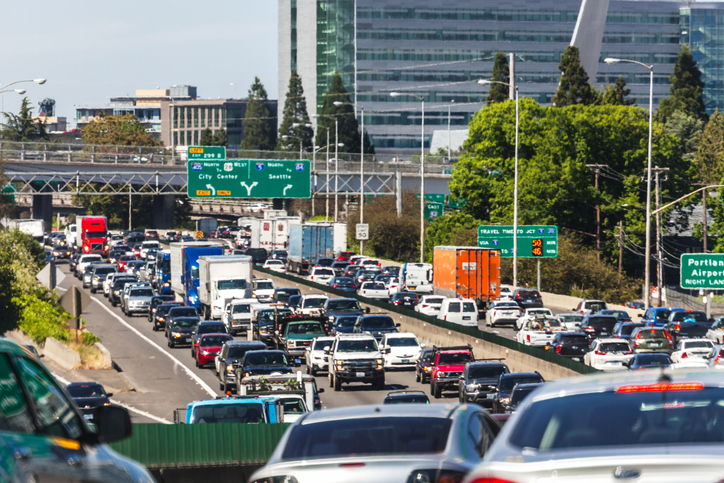
Transportation is the largest source of greenhouse gas emissions in the US, as well as a major contributor of particulate matter (PM) and other pollutants that harm public health. The National Highway Traffic Safety Administration (NHTSA) has been regulating fuel economy since the passage of the Energy Policy and Conservation Act (EPCA) in the 1970s with the aim of conserving fuel and improving vehicle efficiency.
In December 2025, the Trump administration issued a proposal to “substantially recalibrate” the CAFE program. Specifically, NHTSA proposes to significantly reduce the stringency of light-duty vehicle standards, resetting the MY 2022 through 2026 passenger vehicle standards to a 0.5 percent increase, a 0.35 percent increase for MY 2027, a 0.25 percent increase for MY 2028, and then a 0.25 percent increase per year through 2031. The proposal would result in a fleetwide average of approximately 34.5 mpg in 2031. NHTSA argues that these weakened standards represent the “maximum feasible” fuel economy standards that “best reflect and balance the various practical considerations and limitations mandated for the CAFE program.”
NHTSA offers two alternative scenarios in addition to this preferred option, which use different starting points and offer different ramps for future years, with Alterative 3 requiring slightly more stringent fuel economy increases in later years.
Our quick take a looks at fuel economy proposal and details the issues we’ll be watching as NHTSA finalizes it.
Warning: Undefined variable $post_type_name in /nas/content/live/harvardeelp/wp-content/themes/eelp_2024/template-parts/content.php on line 80
On November 17, 2025, the US Environmental Protection Agency and the Department of the Army (“the agencies”) proposed a rule revising the definition of waters of the United States (WOTUS).[1] The agencies stated that they intended to narrow federal jurisdiction to align implementation of the Clean Water Act (CWA) with the Supreme Court’s decision in Sackett v. EPA.[2]
The Clean Water Act[3] prohibits unpermitted discharges into waters of the United States.[4] Only discharges of a pollutant[5] into bodies of water that fall within the definition of WOTUS require a federal permit under the CWA. As a result, the scope of this definition is critical to federal authority to protect water quality, which EPA found in a 2024 report to Congress remains a significant challenge.[6]
In May 2023, the Supreme Court narrowed the definition of waters of the United States in Sackett v. EPA,[7] concluding that WOTUS only covers adjacent wetlands that have a “continuous surface connection” to a “relatively permanent body of water connected to traditional interstate navigable waters.”[8] In response, the Biden administration in 2023 promulgated an updated WOTUS rule to conform to the Court’s ruling.[9] However, states challenged the 2023 rule in court, and as a result, those 26 states have reverted to the an older version of the rule while 24 states continue to follow the 2023 rule.[10] Some states have responded by expanding protections for state wetlands and waters not covered by the ruling.[11] The agencies state in the proposal that the revised WOTUS definition is “intended to adhere faithfully to the Supreme Court’s direction” in Sackett.[12]
Under the agencies’ proposed rule, waters of the United States would include:[13]
In the following sections, we describe some of the changes in this rule.[14]
The proposal removes the category of “interstate waters” as an independent basis for jurisdiction. Instead, these waters must fall into another covered category. The agencies have regulated these waters as jurisdictional under the Clean Water Act since the agencies’ first regulations in the 1970s.[15] Nonetheless, the agencies now propose that “regulating all interstate waters […] regardless of their connection to navigability” would be an impermissible interpretation of the statute.[16] The majority in Sackett does not specifically state whether Congress intended to separately regulate interstate waters that are not relatively permanent, standing, or continuously flowing or that are not themselves connected to a downstream traditional navigable water or the territorial seas, either directly or through one or more waters or features that convey relatively permanent flow.
The proposed rule defines a “tributary” as “a body of water with relatively permanent flow, and a bed and bank, that connects to a downstream traditional navigable water or the territorial seas, either directly or through one or more waters or features that convey relatively permanent flow.”[17] Tributaries under the proposed rule may connect through certain features, both natural and artificial, even if such features themselves are non-jurisdictional, so long as those features have “relatively permanent flow.”[18] Under Sackett, tributaries covered by the CWA must “‘form[] geographic[al] features’ . . . described in ordinary parlance as ‘streams, oceans, rivers, and lakes’.’’[19] The agencies state that this proposed definition is consistent with Sackett and will provide “clarity to assist with implementation” of the rule.[20]
The agencies propose to define and apply terms that the Supreme Court used in Sackett without explicitly defining them, including “relatively permanent” and “continuous surface connection.”[21] Under the proposal, tributaries, lakes, and ponds must be “relatively permanent” to be jurisdictional under the CWA, which the agencies propose to define as “standing or continuously flowing bodies of surface water that are standing or continuously flowing year-round or at least during the wet season.”[22] The proposal also states that adjacent wetlands and relatively permanent lakes and ponds must have a “continuous surface connection” to a water of the United States to be covered under the CWA, which the proposal would define as “having surface water at least during the wet season and abutting (i.e., touching) a jurisdictional water.”[23] The agencies assert that these proposed definitions, which incorporate wet season conditions into assessing jurisdictional waters, are consistent with Sackett, and request comment on how to identify the wet season.[24]
The proposal retains the 2023 WOTUS rule definition of “adjacent,” defined as “having a continuous surface connection.”[25] The Court recognized that WOTUS includes wetlands that are adjacent to traditional navigable waters and other jurisdictional waters,[26] and should be “as a practical matter indistinguishable” from those waters.[27]
The agencies propose to update certain exclusions from WOTUS “based on the case law and the agencies’ long-standing practice and technical judgment” and stakeholders’ need for “clear” exclusions.[28] The proposal would modify existing exclusions for waste treatment systems, prior converted croplands, and ditches, with many of the changes in alignment with the 2020 Trump-era WOTUS rule.[29] To “provide clarity,” the agencies propose to exclude groundwater, which the agencies state has never been covered by past WOTUS definitions.[30] In addition, it would affirm that “ephemeral waters” such as waters caused by precipitation are not covered because they are not “relatively permanent.”[31]
We will be watching to see how the agency responds to public comment in finalizing the rule and whether and how states, Tribes, and local governments respond to federal regulatory gaps by expanding protections for their waters. Follow developments on our Defining Waters of the United States regulatory tracker page.
[1] “Updated Definition of ‘Waters of the United States,’” 90 FR 52498 (Nov. 2025).
[2] Id.
[3] Federal Water Pollution Control Act Amendments, Pub. L. 92-500, 86 Stat. 816 (1972).
[4] 33 U.S.C. §§1311(a), 1344(a), 1362(7).
[5] Under the Clean Water Act, pollutant is defined broadly: “The term “pollutant” means dredged spoil, solid waste, incinerator residue, sewage, garbage, sewage sludge, munitions, chemical wastes, biological materials, radioactive materials, heat, wrecked or discarded equipment, rock, sand, cellar dirt and industrial, municipal, and agricultural waste discharged into water.” 3 U.S.C. § 1362(6).
[6] EPA, National Water Quality Inventory: A Report to Congress (2024).
[7] 598 U.S. 651 (2023) (defining the scope of WOTUS in reference to adjacent wetlands). See also Harvard EELP, Sackett v. EPA: Departure from Textualism Significantly Limiting Clean Water Protection (June 2023); Richard Lazarus, Judicial Destruction of the Clean Water Act: Sackett v. EPA, U. Chi. L. Rev. Online (Ag. 2023).
[8] Sackett at 678.
[9] “Revised Definition of ‘Waters of the United States,” 88 FR 61964 (Sept. 2023).
[10] EPA, Definition of Waters of the United States: Rule Status and Litigation Update (2025).
[11] See, e.g., New Mexico SB 21 and 22 (2025).
[12] 90 FR 52498.
[13] 90 FR 52498, 52514.
[14] Note that in addition to this proposed definition, the agencies request comment on an even narrower alternative approach limiting the definition of WOTUS based on “traditional navigable waters, tributaries that directly flow into these waters, and wetlands with a continuous surface water connection to such waters” based on Justice Thomas’s Sackett concurrence. Specifically, EPA states: “This alternative is informed by Justice Thomas’s concurring opinion in Sackett, which emphasized that “the term ‘navigable waters’ refers solely to the aquatic channels of interstate commerce over which Congress traditionally exercised authority.” 598 U.S. at 697 (Thomas, J., concurring). The agencies seek comment on whether the statute and the relevant history of Federal authority over navigable waters support this approach…” 90 FR 52515.
[15] 38 FR 13528 (1973).
[16] 90 FR 52516.
[17] 90 FR 52498, 52521.
[18] The agencies explain that the “proposed definition of ‘tributary’ clarifies that a ‘tributary does not include a body of water that contributes surface water flow to a downstream jurisdictional water through a feature such as a channelized non-jurisdictional surface water feature, subterranean river, culvert, dam, tunnel, or similar artificial feature, or through a debris pile, boulder field, wetland, or similar natural feature, if such feature does not convey relatively permanent flow.’” 90 FR 52521.
[19] Sackett, 598 U.S. at 671.
[20] 90 FR 52522.
[21] While Sackett generally adopted the Rapanos v. United States plurality’s formulation of “relatively permanent” and of adjacency as “continuous surface connection,” Sackett did not explicitly define these terms. Sackett, 598 U.S. at 671, 678.
[22] 90 FR 52498, 52517–18.
[23] Id. at 52527; see also 90 FR 52498, 52517–18, 52528 (acknowledging circumstances that may cause surface hydrology not to overlap exactly with the wet season).
[24] The agencies explain that there may be regional variation in a wet season: “The time period that encompasses flow during the wet season can vary across the country based upon climate, hydrology, topography, soils, and other conditions.” Id. at 52518.
[25] “Revised Definition of ‘Waters of the United States’” 88 FR 61964, 61968 (Sept. 2023); 33 CFR 328.3(c)(2), 40 CFR 120.2(c)(2).
[26] Rapanos v. EPA, 547 U.S. at 741 (Scalia, J., plurality opinion) (citing 33 U.S.C. 1344(g)(1)); Sackett, 598 U.S. at 676 (citing 33 U.S.C. 1344(g)(1)).
[27] The Court stated that this “indistinguishable” test of adjacency has two requirements: (1) the wetland is adjacent to a body of water that is itself covered by WOTUS (i.e., a relatively permanent body of water connected to traditional navigable waters) and (2) the wetland or relatively permanent lake or pond “has a continuous surface connection with that water, making it difficult to determine where the “water” ends and the “wetland” begins.’” Sackett, 598 U.S. at 678–79.
[28] 90 FR 52534.
[29] Id. at 52498, 52534–41.
[30] Id. at 52498, 52534–41.
[31] Id. at 52517-18.
Warning: Undefined variable $post_type_name in /nas/content/live/harvardeelp/wp-content/themes/eelp_2024/template-parts/content.php on line 80
Warning: Undefined variable $post_type_name in /nas/content/live/harvardeelp/wp-content/themes/eelp_2024/template-parts/content.php on line 80